
National Cemetery
The San Francisco National Cemetery in the Presidio.
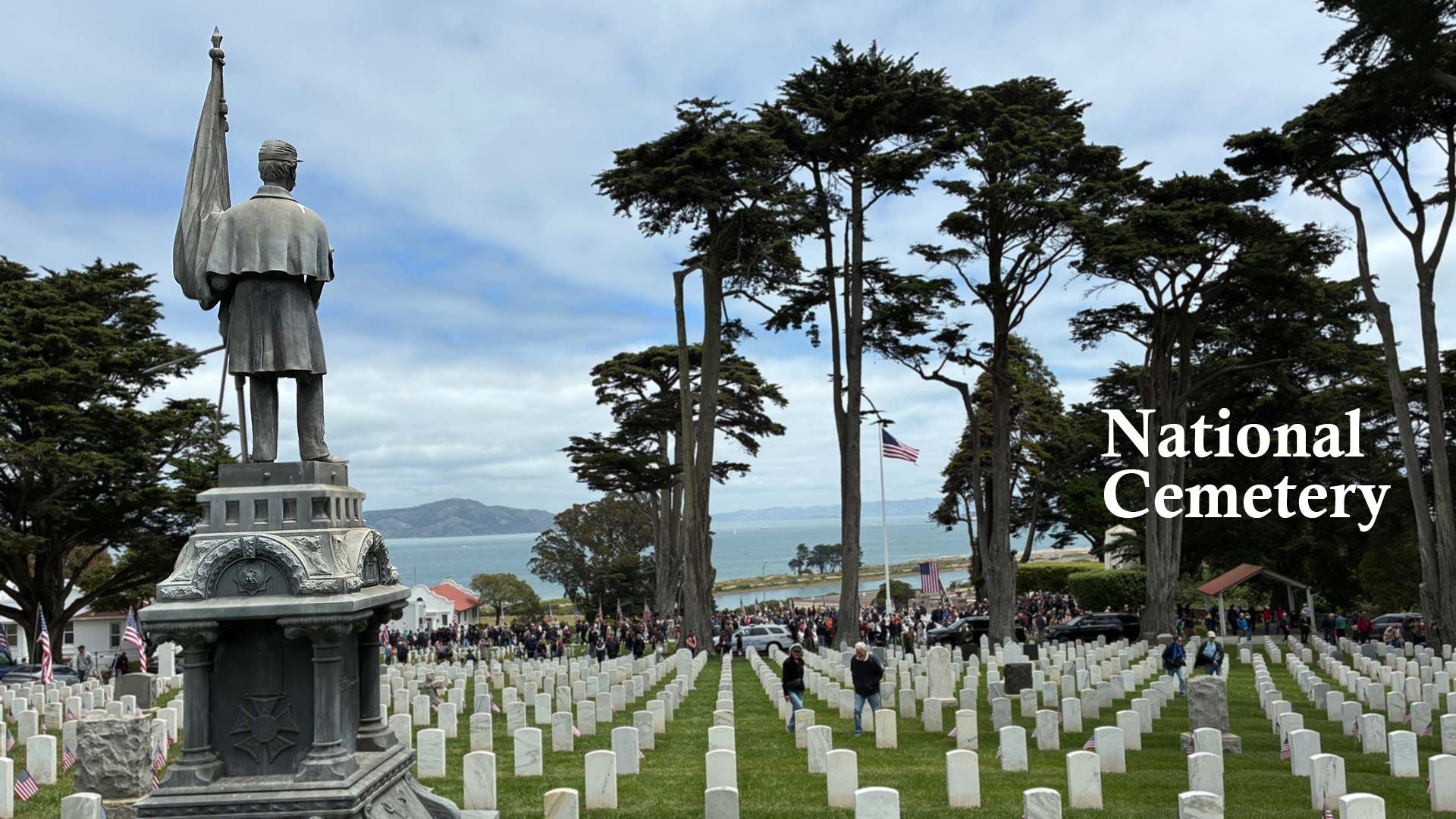
I try to treat Memorial Day the right way. In past years I have visited Gold Star corners and the Grove of Memory. This year, I walked the entire 28 acres of the San Francisco National Cemetery at the Presidio of San Francisco.
The Presidio burial ground is a short walk to the west from the parade ground food trucks and deservedly popular Tunnel Tops. Created in the 1850s, it was given designation as a national cemetery in 1884.
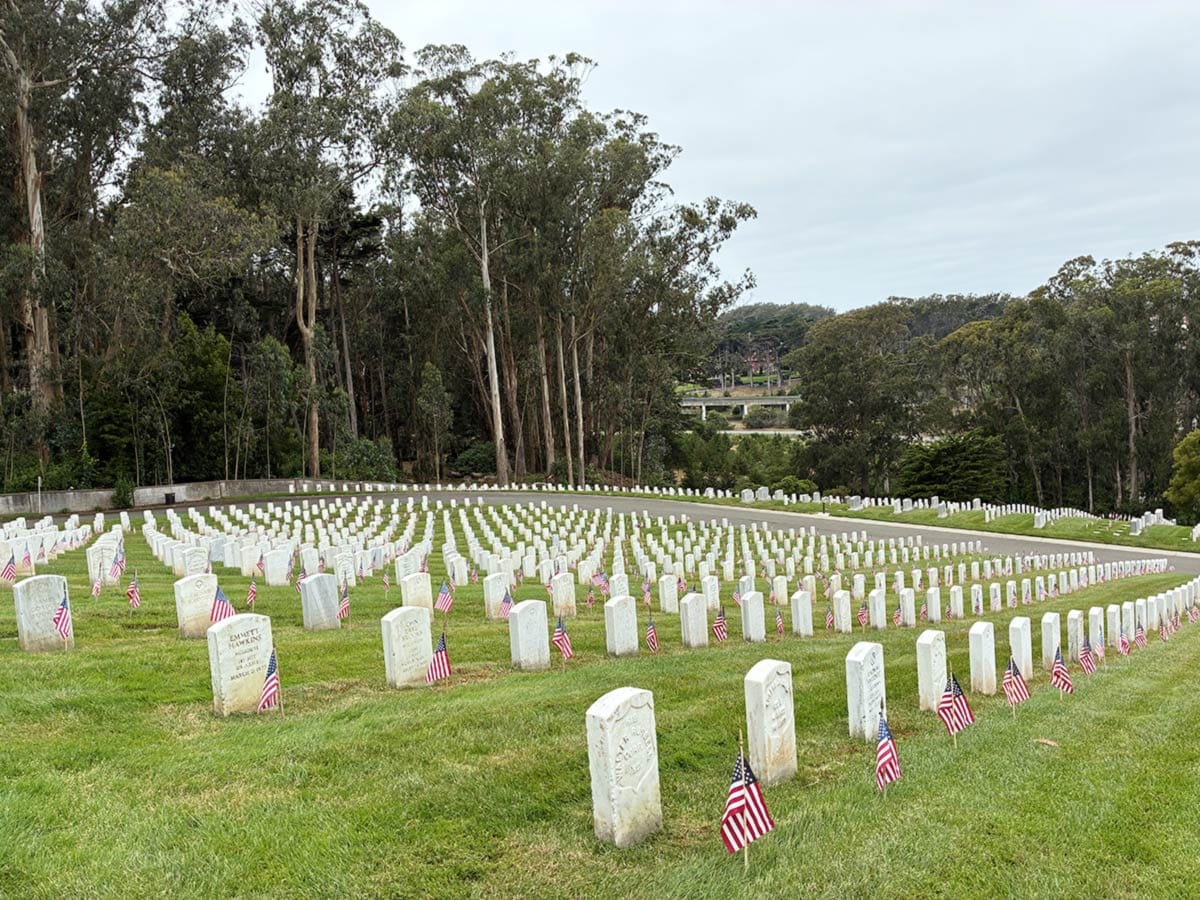
Congress authorized national cemeteries to recognize and maintain final resting places for those who gave their lives in service of the country during the Civil War—a conflict in which roughly two percent of the national population died.
Until the 1930s, the San Francisco National Cemetery was the only one on the west coast. In addition to service men and women, the burial ground holds the remains of wives, children, and bodies relocated from western army posts and battlefields.
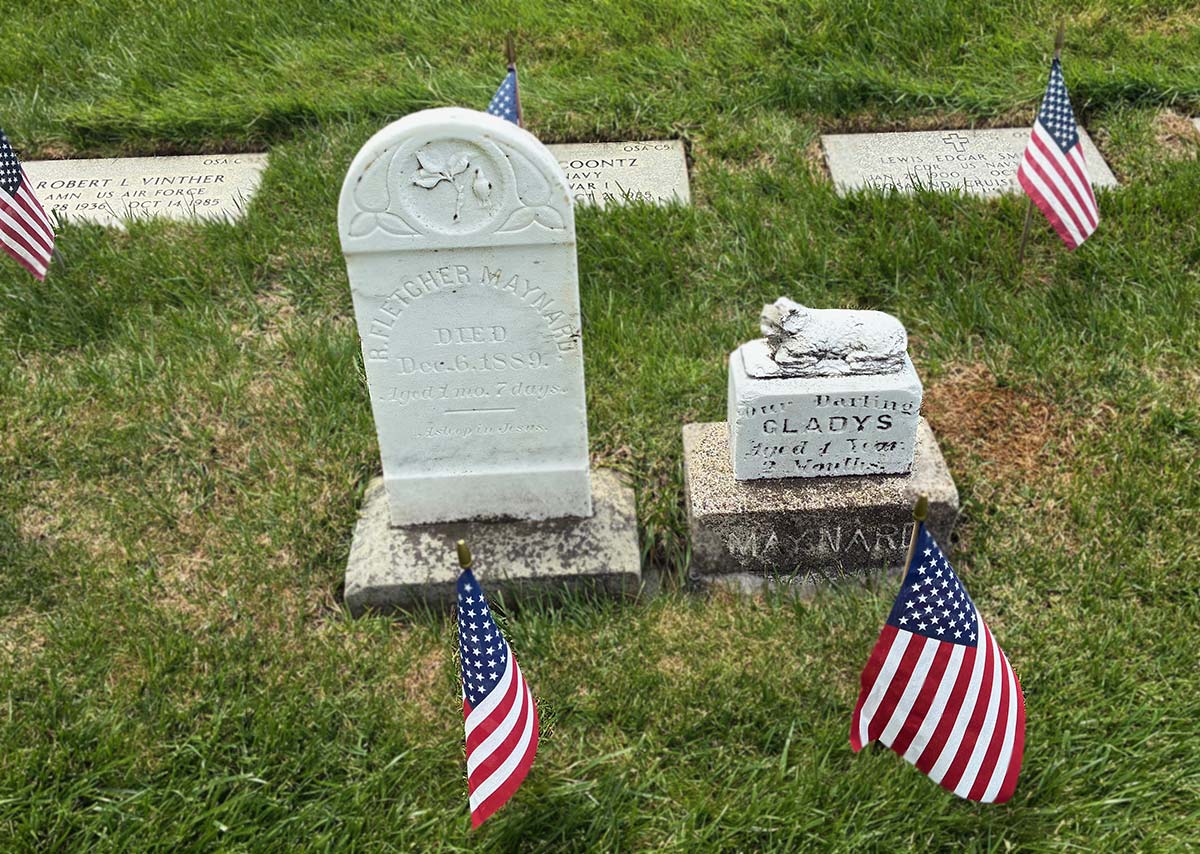
There is a scout just named Two Bits with a marker. Pauline Cushman Fryer, a woman who died dissolute in a Market Street flophouse in her 60s, but known as a spy for the Union Army during the Civil War is here.
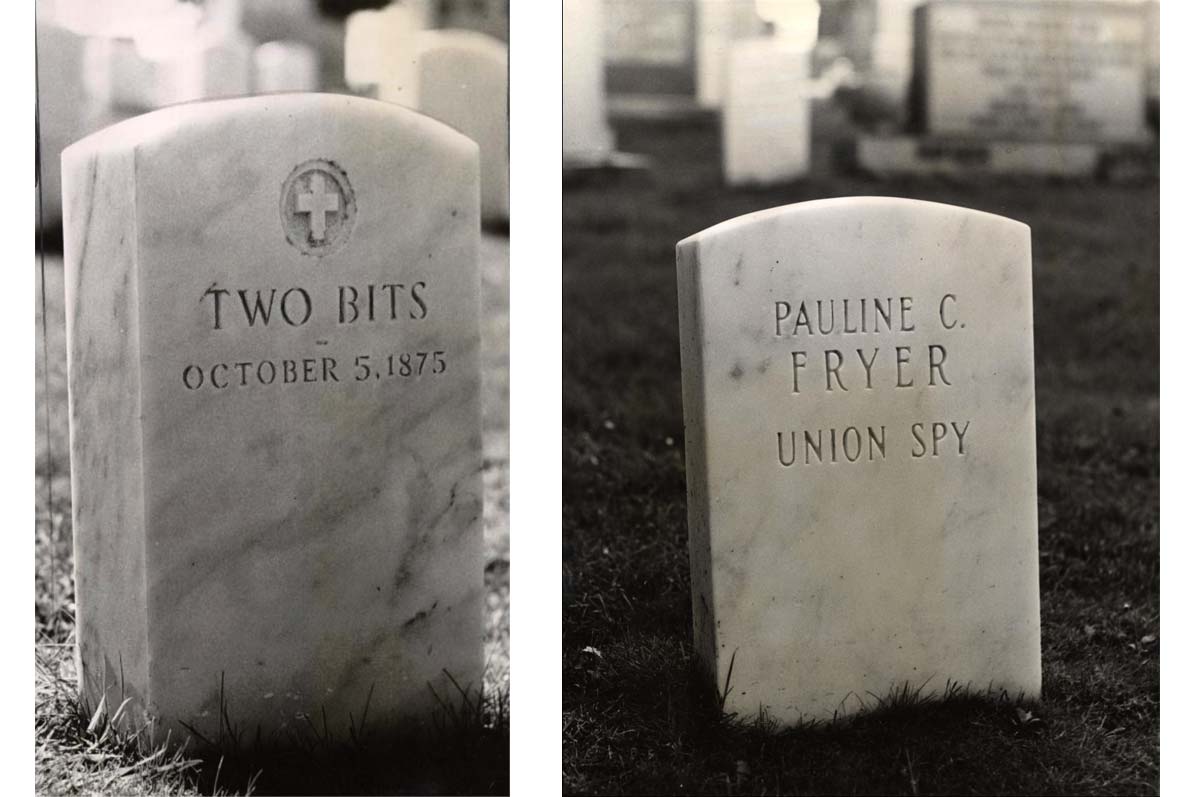
More than 450 Buffalo Soldiers are interred here. Naval personnel buried on Yerba Buena Island were removed to the Presidio during construction of the Bay Bridge. There is even a soldier or two who fought on the Confederate side among the rows.
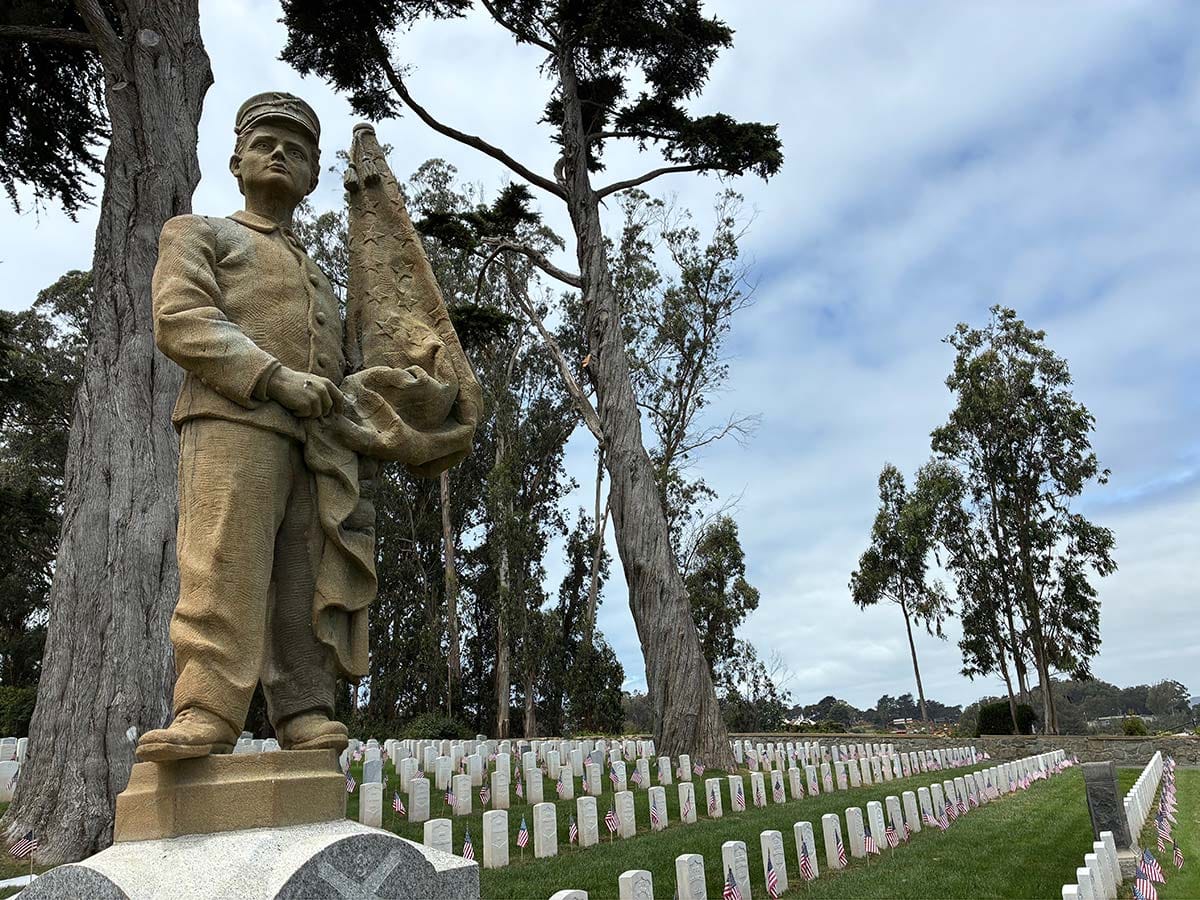
Before the cemetery’s establishment, Presidio burials were made near the laundresses’ quarters just west of today’s parade ground.
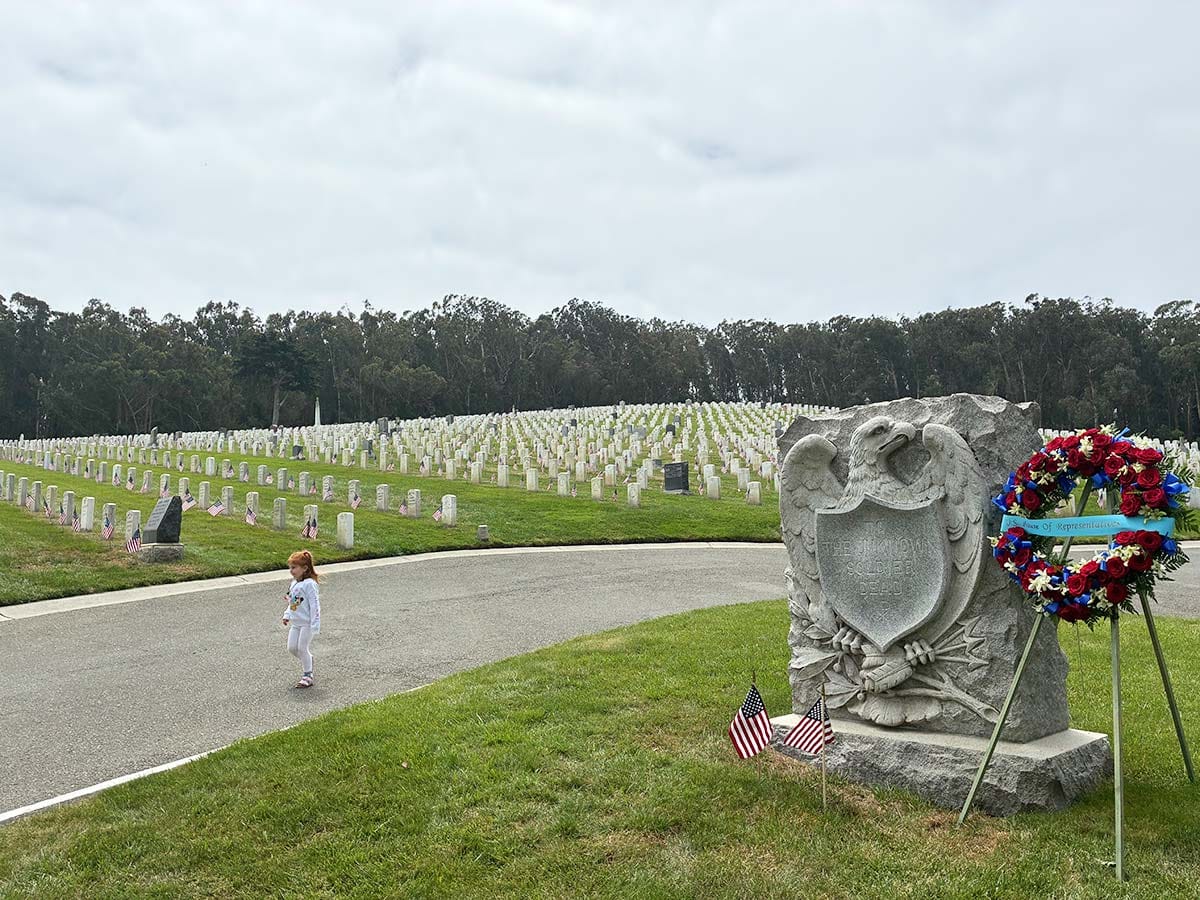
Those remains and any others found on post over later decades were reinterred in a plot of “unknowns” in the national cemetery. So the bones of people who perhaps never had anything to do with United States military service, like men and women from the Spanish Empire, the Mexican Republic, and even perhaps pre-colonial Ohlone people, are also here.
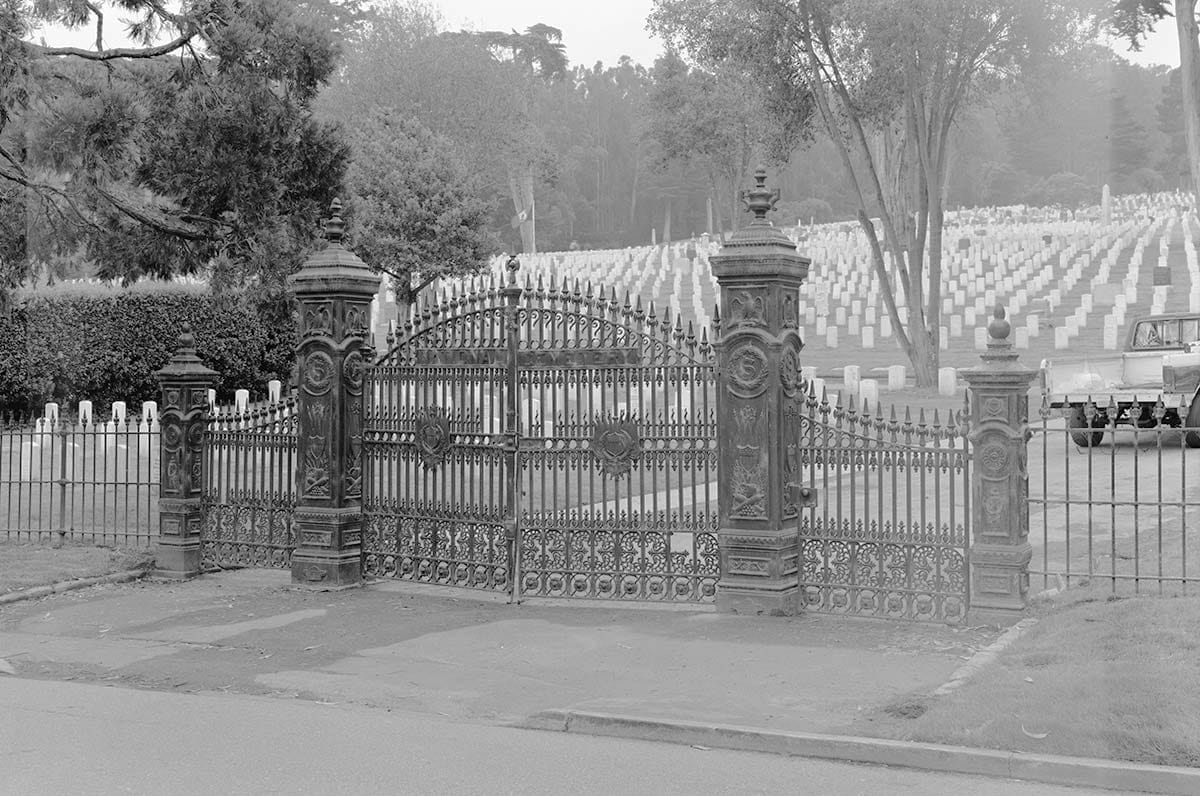
The 1867 National Cemeteries Act directed enclosure of burial grounds with masonry walls and ornamental entry gates. When the Presidio cemetery expanded to the south and west, quadrupling in size by the 1930s, both walls and gates were adjusted in accommodation.
From nine-and-a-half acres, the cemetery expanded with additions in 1896, 1919, 1924, 1928, and in 1932 reached its present size of 28.34 acres.
A superintendent lodge constructed in 1884 was remodeled in Spanish Colonial Revival style in 1929. The Presidio cemetery’s rostrum, made for ceremonies on Memorial Day and other occasions, dates from 1915.
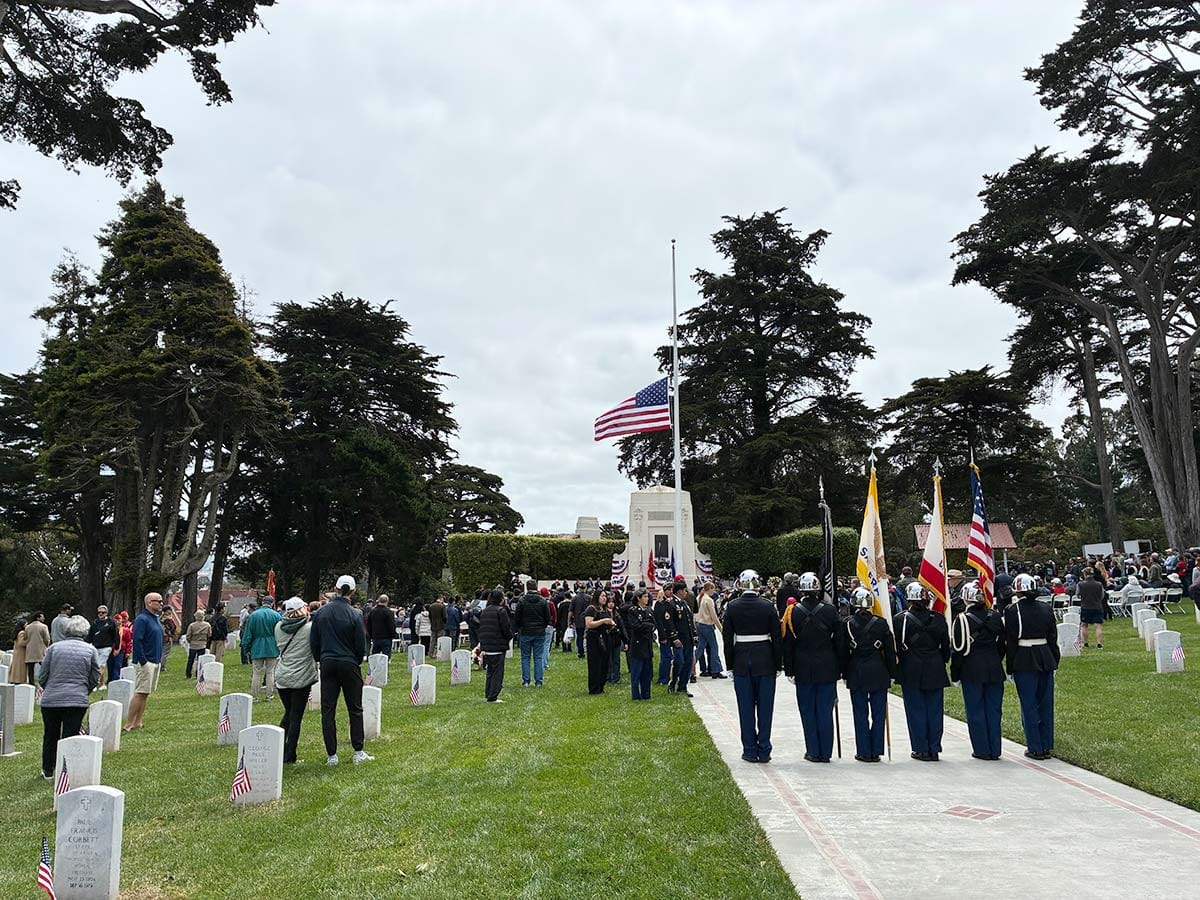
The 116,516 American dead of World War I, and veterans’ benefits promising burial space to each of the five million men and women who served in that conflict, required an expansion of the national cemetery system.
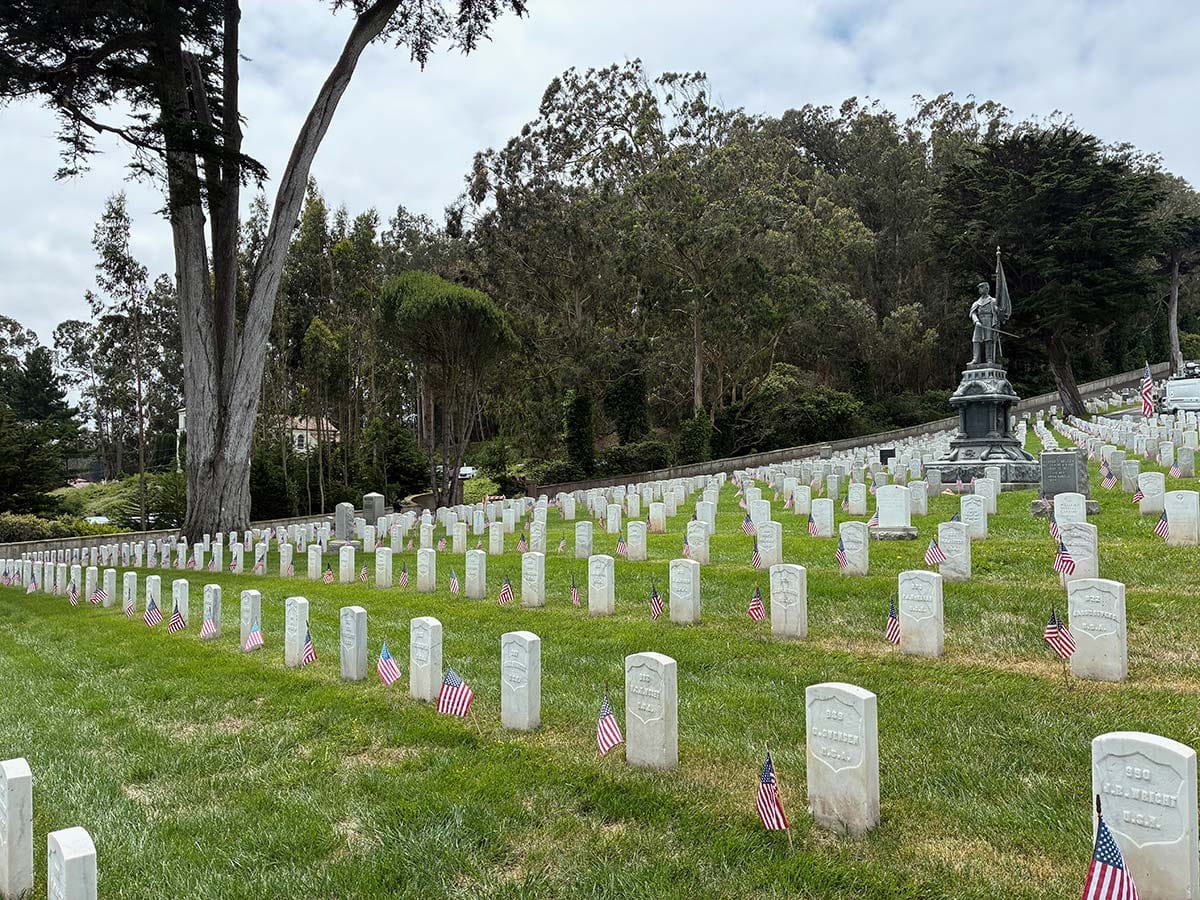
Between 1934 and 1939, seven new national cemeteries were created near large population centers in California, Maryland, Minnesota, New York, and Texas. The Golden Gate National Cemetery in San Bruno opened just in time for World War II when millions served and more than 400,000 Americans perished in service.
It is in San Bruno where my grandfather, Eugene Slinkey, is buried.
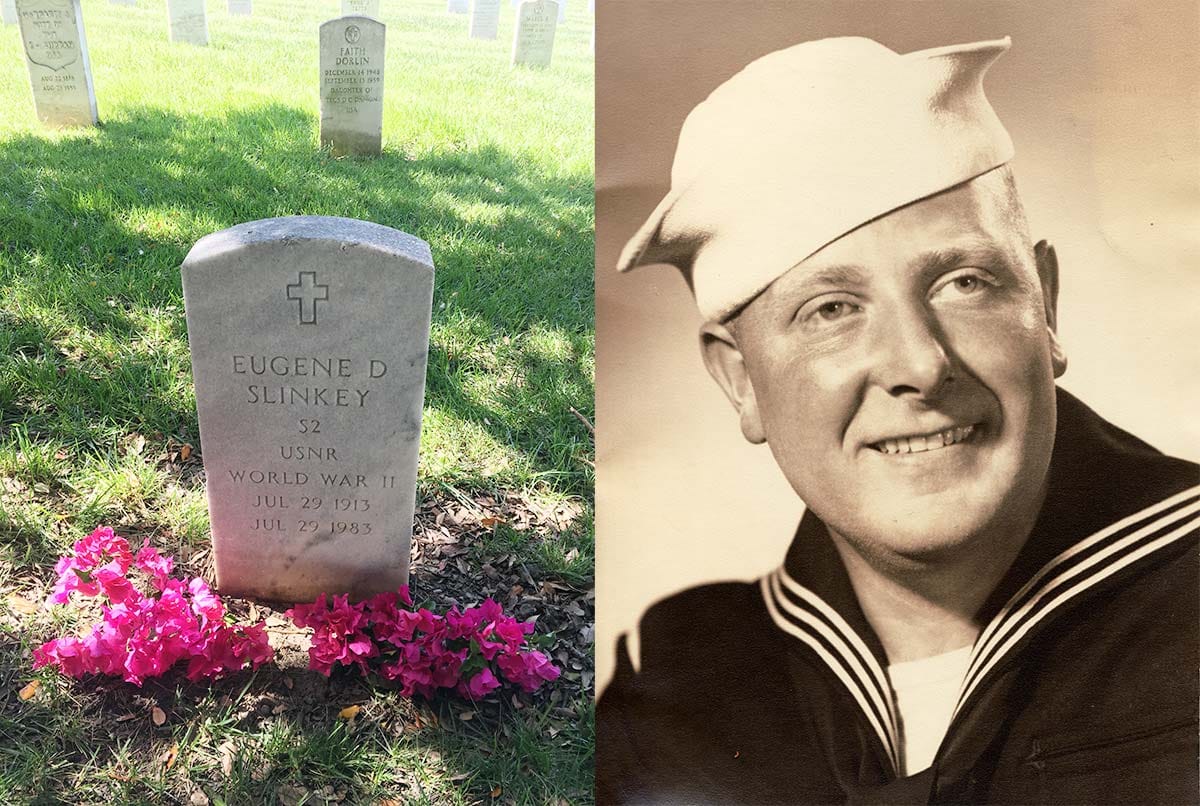
The dead in national cemeteries rested first below wooden headboards and stone blocks before the “General” design of arched white tombstones and later flat bronze markers were adopted.
The uniformity makes for poignant landscapes, but it is also egalitarian and touching. Fleet Admiral Chester W. Nimitz and my grandfather, a cook on a transport ship, get the same treatment.
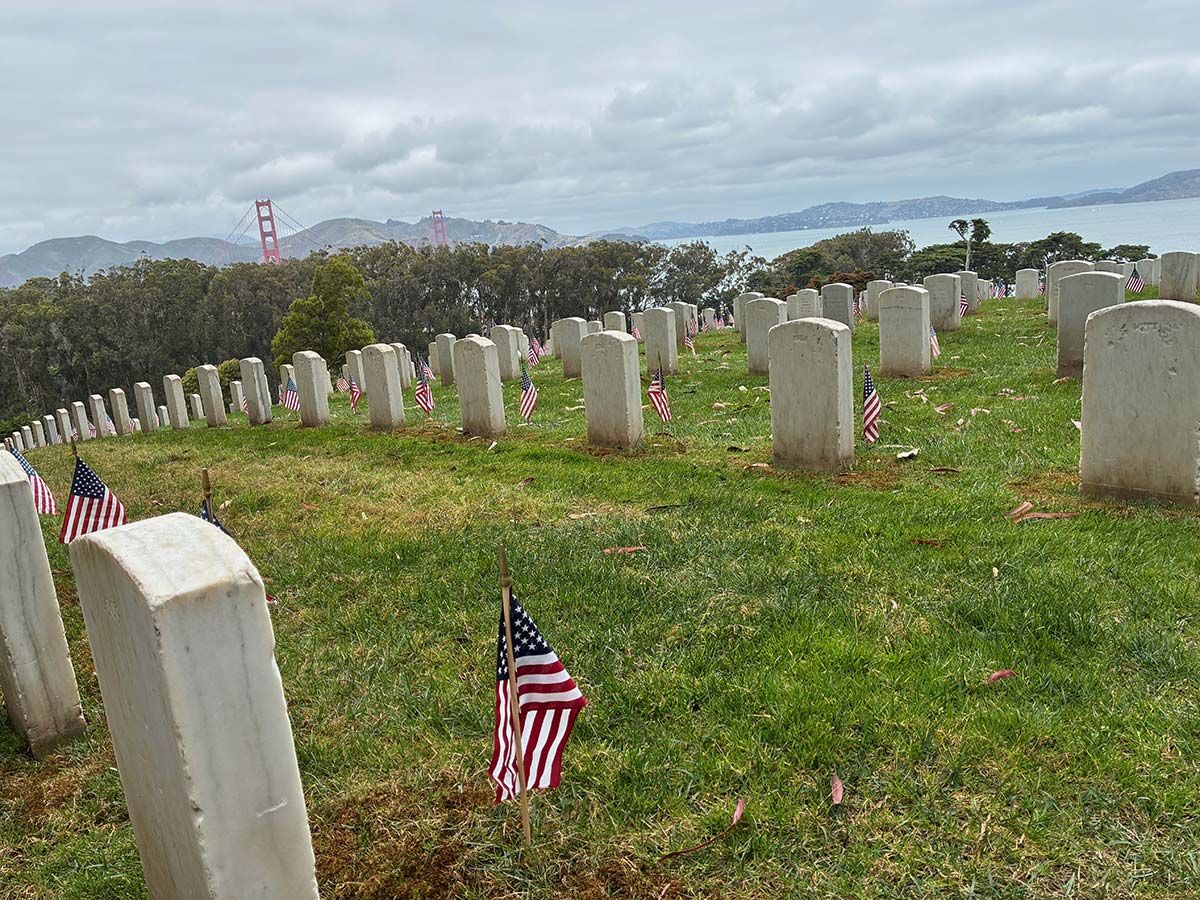
The Presidio cemetery had around 200 graves when it was given national cemetery status in the 1880s. By the end of World War II the San Francisco National Cemetery held more than 20,000 individuals.
While officially closed to new burials at that time, reservations and subsequent interments stretching into the 21st century has pushed that number to over 30,000.
In 1973, the army transferred all national cemeteries to the Department of Veterans Affairs. The Presidio is now a national park, but the VA still maintains the cemetery.
One of my Presidio walking loops takes me on a little-known forested path tucked behind a row of 1940s officers’ housing. The path leads to an opening in the eucalyptus and ivy with a prospect over the cemetery.
The Presidio has added some benches, a wall, and signage here, calling it the National Cemetery Overlook.
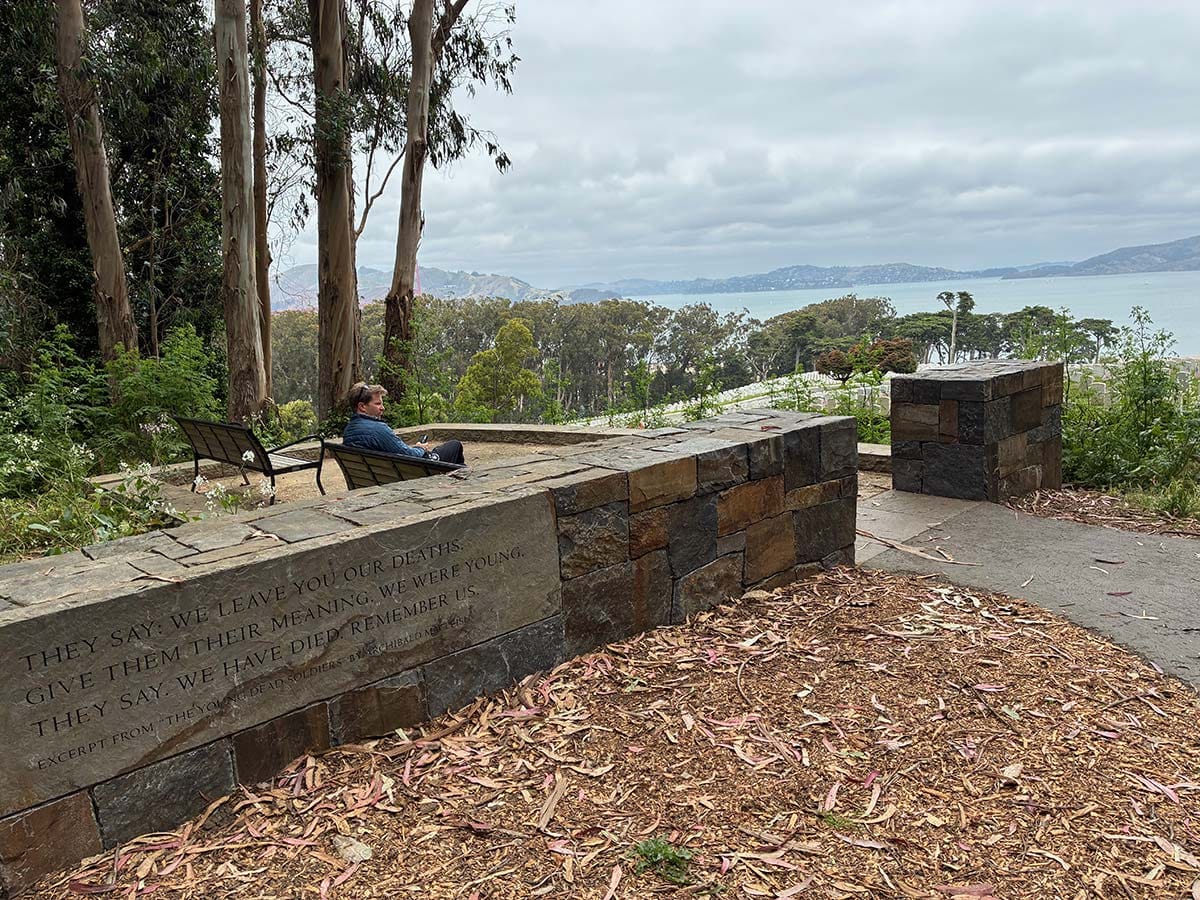
In among the trees you are emotionally set apart as an almost other-worldly observer of the sparkling white rows of tombstones.
It is a picturesque spot with the Golden Gate Bridge as background. It is also strangely noisy because of the traffic roaring just out of sight on the Presidio Parkway.
Inscribed in the overlook walls are select stanzas from Archibald MacLeish’s poem, The Young Dead Soldiers.
In 2026, with us now once again at war, they are worth reading:
They say: We were young. We have died. Remember us.
They say: Our deaths are not ours; they are yours; they will mean what you make them.
They say: Whether our lives and our deaths were for peace and a new hope or for nothing we cannot say; it is you who must say this.
They say: We leave you our deaths. Give them their meaning. We were young, they say. We have died. Remember us.
Woody Beer and Coffee Fund
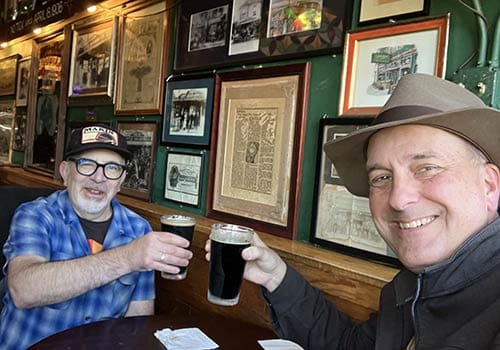
The scoop for those of you new to the scene: the Woody Beer and Coffee Fund is where people give me donations that I use to buy drinks for people who want to chat with me.
You can be a donor, you can be a beneficiary, you can be both! (You can be none of the above too, I suppose.)
Sometimes I even purchase people a pastry or plate of enchiladas with the bank...I am capricious and generally not to be relied upon to stick to rules I make.
So when are you free? Let’s set this up.
Sources
Mark L. Brack and James P. Delgado, “Presidio of San Francisco National Historic Landmark District,” Historic American Buildings Survey Report, 1985.
Erwin N. Thompson and Sally B. Woodbridge, “Special History Study, Presidio of San Francisco: An Outline of Its Evolution as a U.S. Army Post, 1847-1990,” August 1992.
Erwin N. Thompson, “Defender of the Gate: The Presidio of San Francisco, A History from 1846 to 1995,” Historic Resource Study, Volume I, Golden Gate National Recreation Area, California, National Park Service, July 1997.
“America’s World War II Burial Program,” National Cemetery Administration, U.S. Department of Veterans Affairs, 2020.