
The Last of Tucker Town
Is San Francisco's oldest tract house in Pacific Heights?

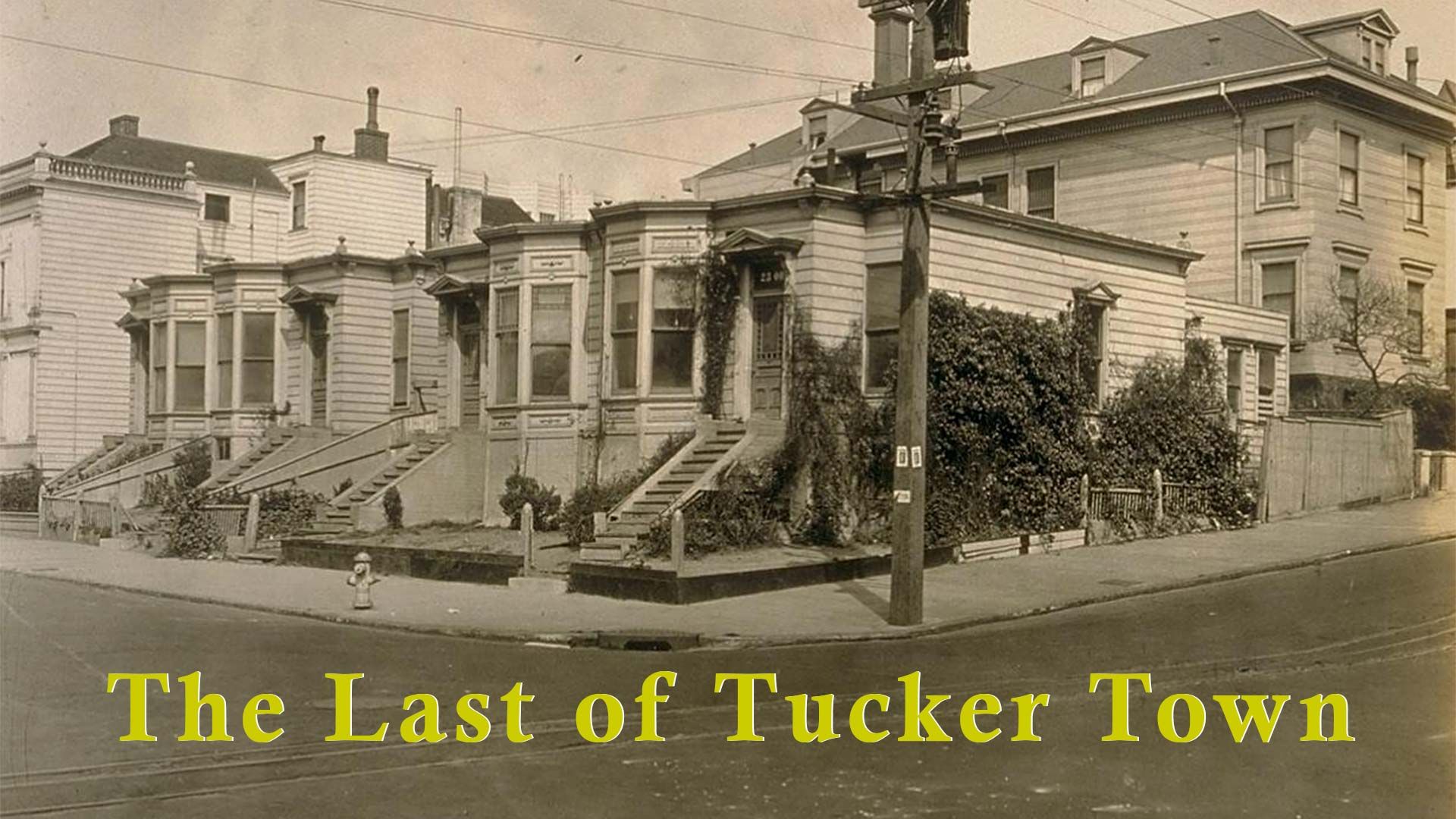
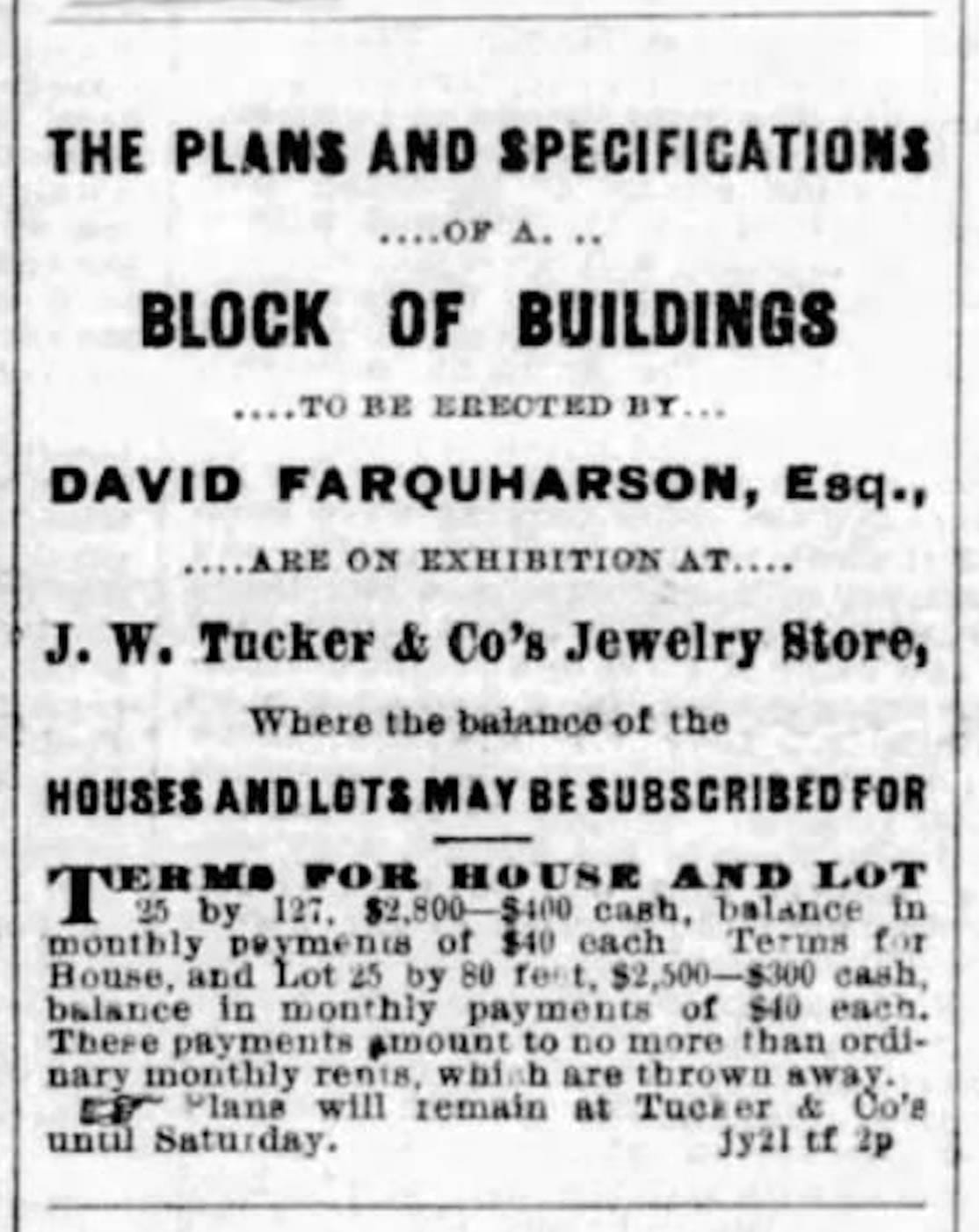
In the summer of 1870, J. W. Tucker & Co.’s jewelry store at 101 Montgomery Street had something a little out of the ordinary on display.
Alongside the watches, rings, and stick pins for which John Tucker was so well known were plans and specifications for an entire block of buildings, a residential subdivision of 40 small cottages designed by architect David Farquharson, Esq.
Building out and offering for sale an entire block of the city was an unusual proposition. The best-known example coming close had been George Gordon’s South Park, an 1850s attempt to create an English-style terrace development between 2nd and 3rd, Bryant and Brannan streets.
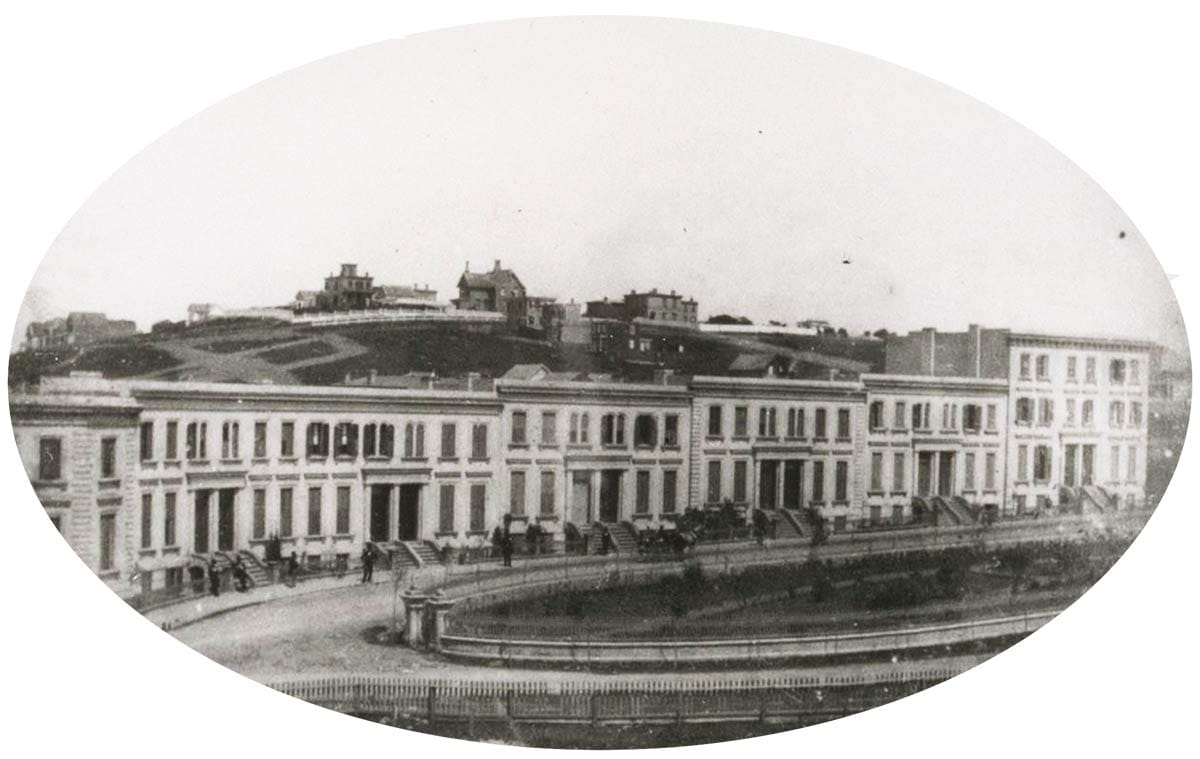
Gordon didn’t fully build out his block and his South Park was fairly close to the young city’s financial and industrial centers. In contrast, most San Franciscans, would have considered “Tucker Town,” out on the block of Buchanan, Webster, Jackson, and Washington streets, living in the country.
Because what we call Pacific Heights today was the boonies in 1870.
The Western Addition
From 1850 to 1855, Larkin Street served as the western boundary of San Francisco. Men and women set up homesteads and small concerns all over the peninsula after the Gold Rush, but with few exceptions, west of Larkin Street they were technically on squatter land contested by private claimants, the city, the state, and the federal government.
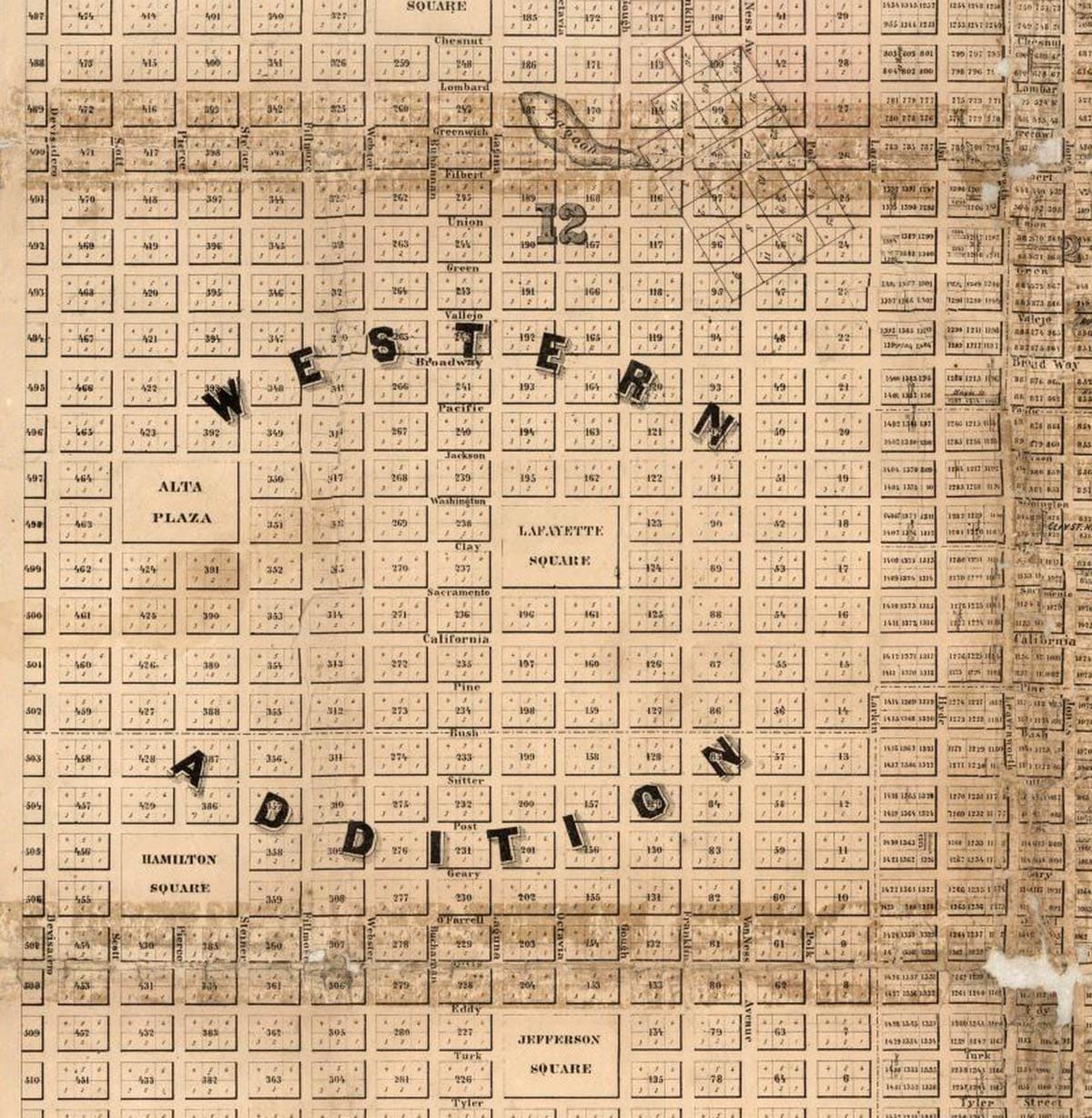
By the middle of the 1850s some 5,000 people were living on the west side with shaky land titles, murky prospects, and desperately hoping to get their patch of ground validated.
Intimidation and violence went hand in hand with the many disputed land claims. The Daily Alta California tsk-tsk’d in one issue when two west side houses were burned to the ground by eight armed men:
“It is a notorious fact that there is a regular gang of ruffians in the Western Addition whose sole business is to hire themselves out to the highest bidder to violently dispossess any party from any property, without reference to the legal rights of anybody; and it seems to us that such a state of affairs reflects no credit upon San Francisco.”
The City of San Francisco passed an 1855 ordinance creating the Western Addition and extending the city limits west from Larkin to Divisadero Street. The law and an official map drawn up in 1856 was meant to quiet the land-title disputes, but legal appeals and ruffian-intimidation continued up to and after Congress formally confirmed the annexation in 1864.
Even if you could be secure in proving title to your Western Addition property, you may not have wanted to live there. In 1870, most of the Western Addition streets were only streets on paper. It was a long walk over Nob or Russian hill to get to the settled parts of town and an even longer hike to get to warehouse and factory jobs South of Market.
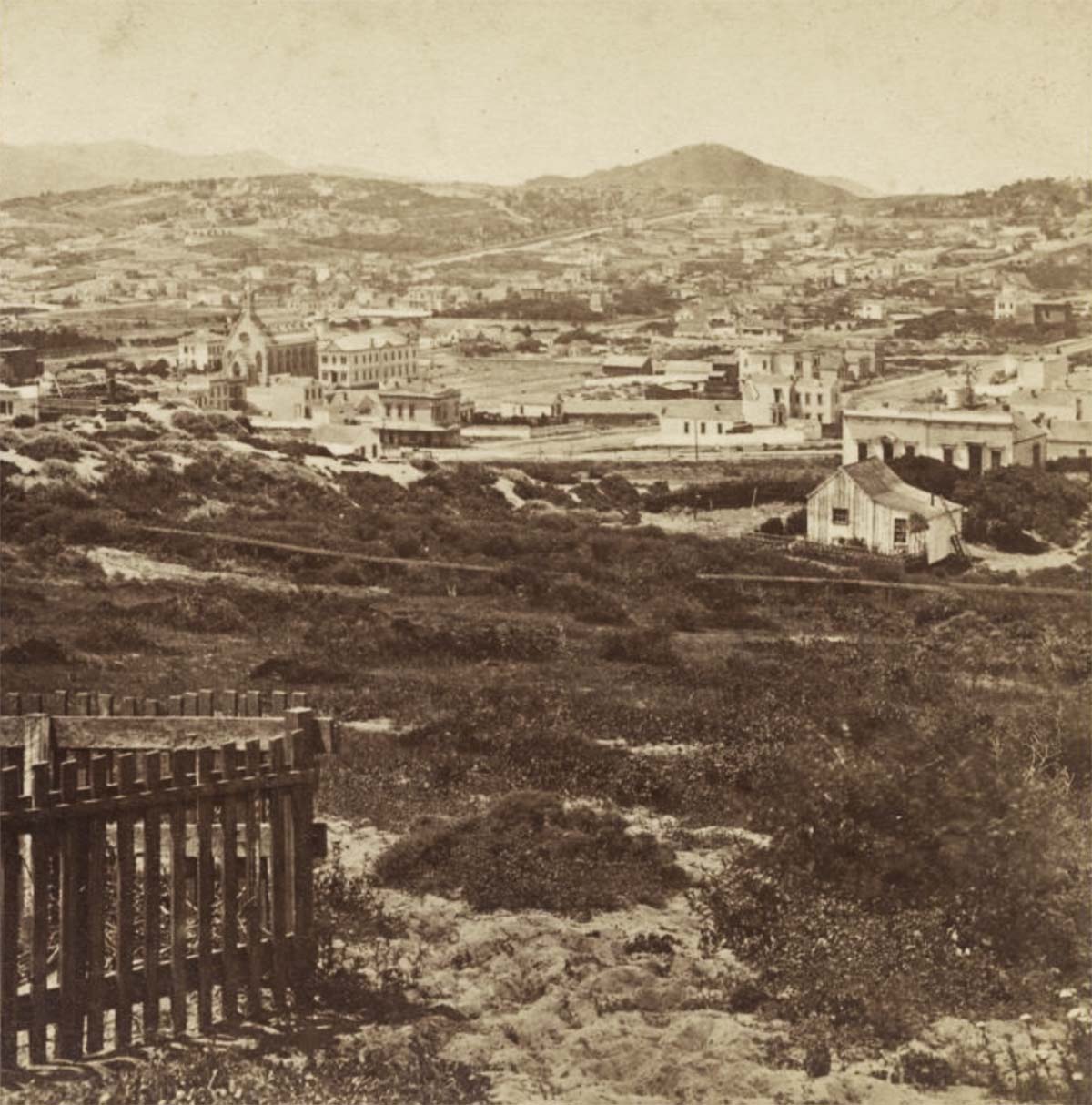
So why did John W. Tucker, the city’s leading jeweler, and David Farquharson, a well-to-do architect and businessman, leap to create one of the city’s first residential subdivisions in the scrubby Western Addition?
Tucker Town
Some developments in the late 1860s may have encouraged the jeweler and the architect.
With the Outside Lands Act of 1866, Congress granted to the City of San Francisco most of the peninsula out to ocean beach. From this settlement of land claims, Golden Gate Park was laid out—at least on maps—in 1870.
Surely, (thought every city real-estate booster), all we need is reliable transportation and the hoards will start snapping up west side properties.
In December 1868, a horsecar line extension of the Front Street, Mission and Ocean Railroad (called the Sutter Street cars by most people) began service along Pacific Avenue. A Bush Street line running to the cemeteries at Lone Mountain followed in 1870.
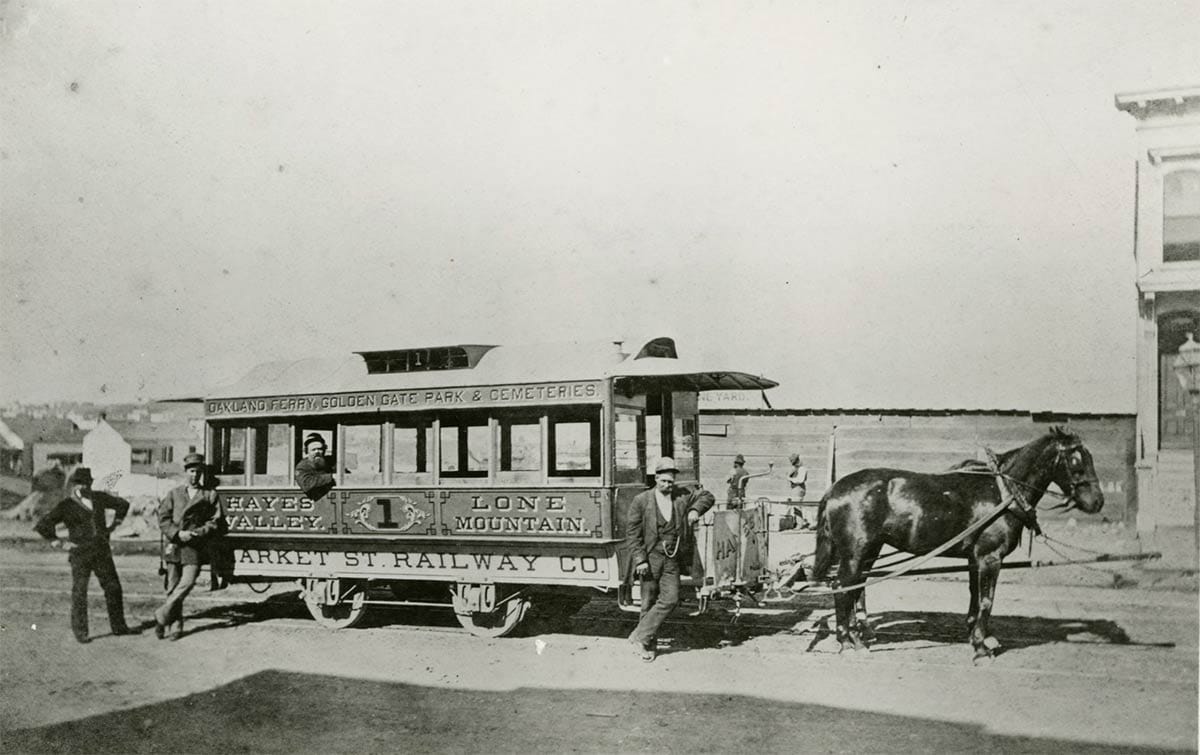
That same year, perhaps banking on these pokey horse-drawn streetcar lines, Tucker Town was born.
Forty cottages were constructed on the block bounded by Buchanan, Webster, Jackson, and Washington streets. The short-block houses on Webster and Buchanan had 25-by-80-foot lots while the Jackson and Washington properties stretched back 127 feet.
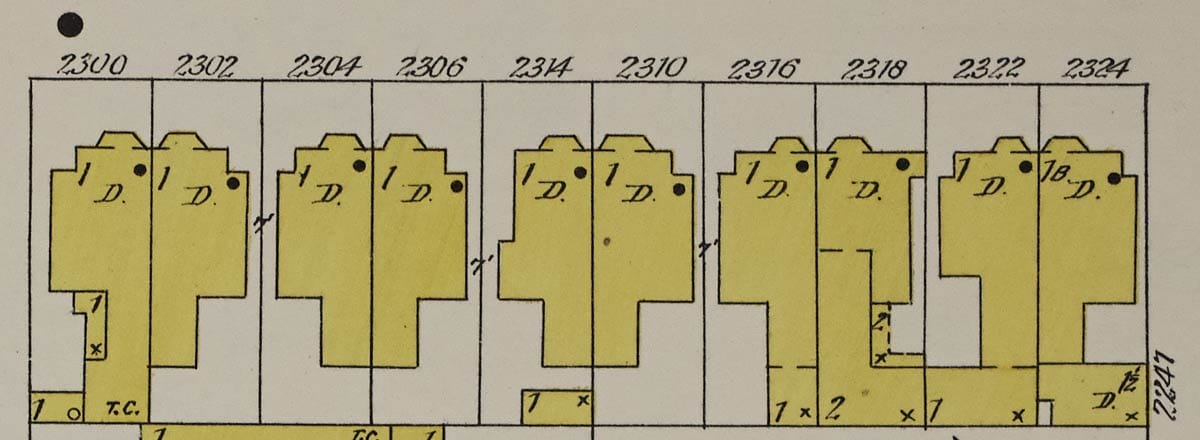
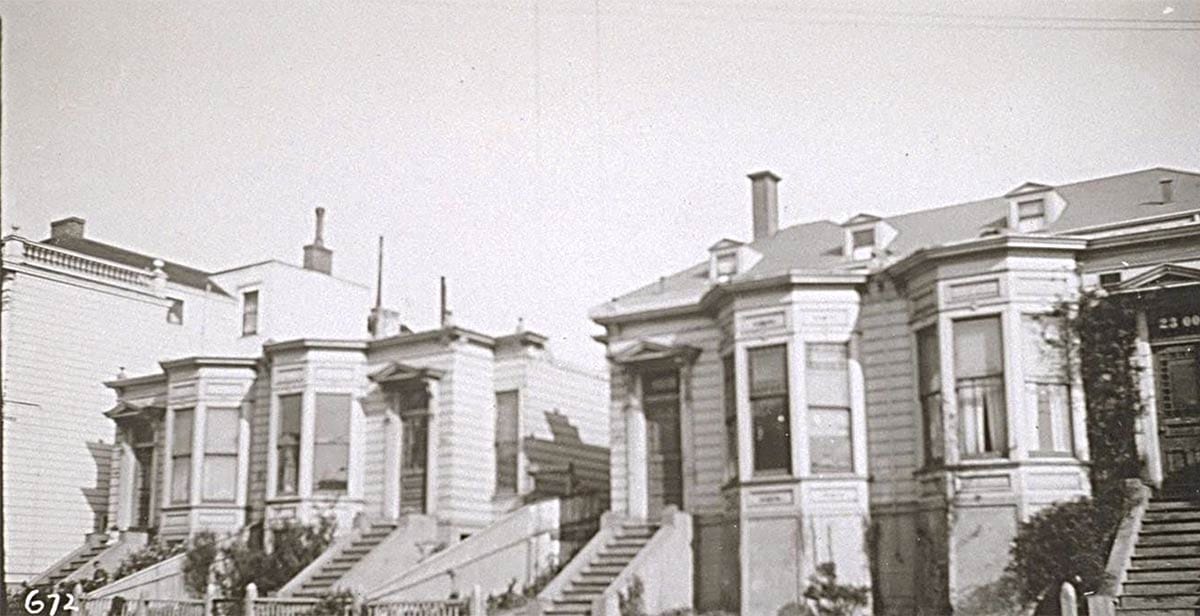
Residences were paired up to allow seven-foot-wide driveways for carriage storage in the back yards. All were initially painted white with white picket fences enclosing pretty front gardens. Columnist Walter J. Thompson remembered them as pretty “birdcage houses, each set in a garden of roses […] which caught the slanting rays of the westward falling sun.”
Each had a bay window with built-in blinds of oiled cedar, marble mantled fireplaces, and parlor woodwork grained in “imitation of oak.” The main section of each cottage had four rooms (parlor, dining room, two bedrooms with closets), while rear wings contained a bathroom, kitchen, pantries, and a small room suitable for a servant.
A limited number of the Tucker Town houses were double-sized, essentially a mirrored floor plan with a center entryway. J. W. Tucker took one of these for himself.
Gas and water lines came included, which was considered a real perk to a reporter visiting the site in 1870 who described the neighborhood as “comparative desolation,” although there were views of the bay and the Golden Gate.
One could purchase a Tucker Town cottage for $2,500 with a deposit of $300 and a five-year payment plan of $40 a month with 10% annual interest. (In 2026 dollars, the full price would be equivalent to about $62,000.) Paying off a house in installments was a new idea.
The subdivision was completed in March 1871 with the down-payment price for the last cottages raised from $300-$400 to $700. Real estate in the area had already started to appreciate.
Most everyone later agreed the jeweler had been a bit too ahead of his time. In 1872, lots on Jackson Street and Pacific Avenue sprouted some of the first Pacific Heights mansions, with building costs 20 times the price of a Tucker Town birdcage.
The Real Estate Associates and other speculative builders followed close on Tucker’s heels and erected lines of elegant Italianate townhouses on Western Addition blocks, including Webster Street right across from Tucker Town.
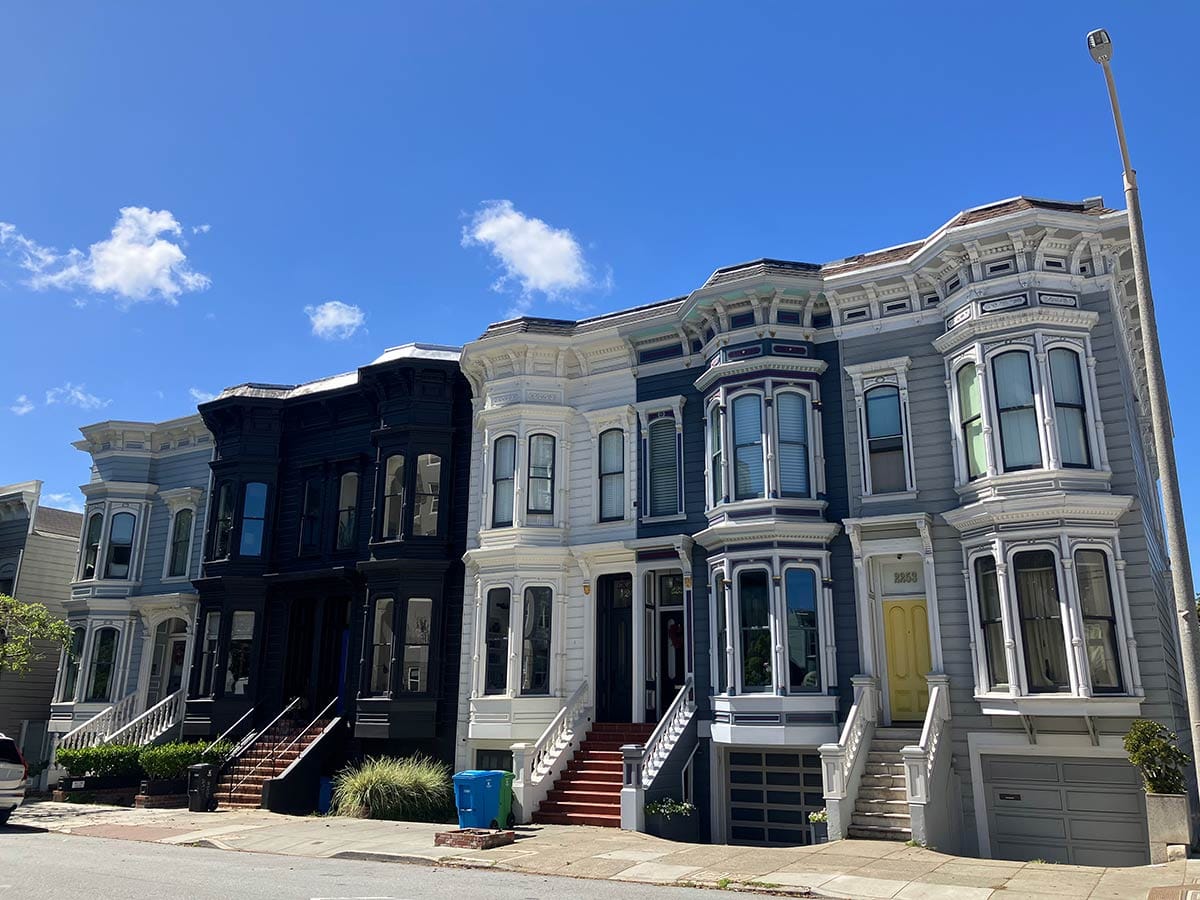
By 1889, the Examiner extolled that the former “sandy, bush-grown ridge” had “blossomed into magnificence and beauty” and that “from Webster street westward almost every house is a mansion or, if a cottage, it is built of a size and upon a plan which entitles it to rank in the same category.”
One by one, over the decades, the modest homes of Tucker Town were eaten up for larger residences or multi-unit apartment buildings. In 1924, Jesse B. Cook went out to document some of the last remaining on the northeast corner of Washington and Webster streets:
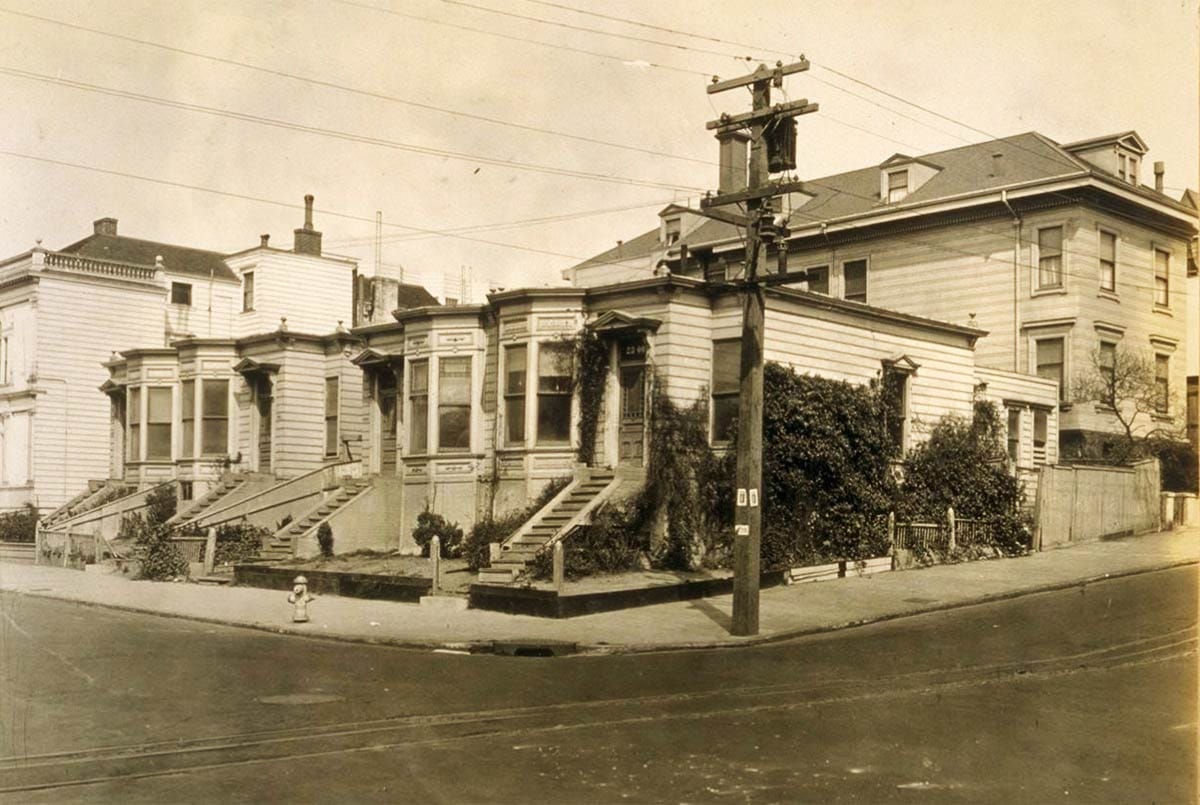
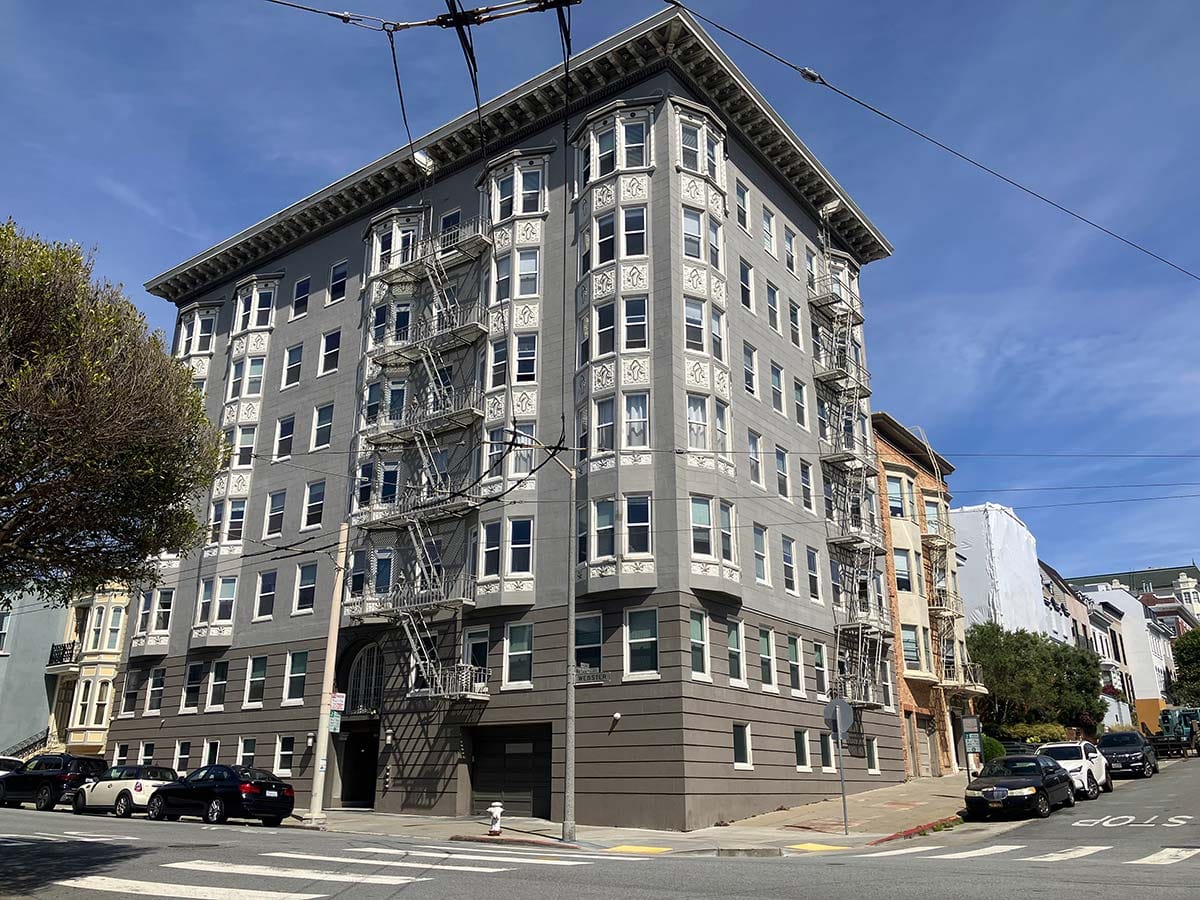
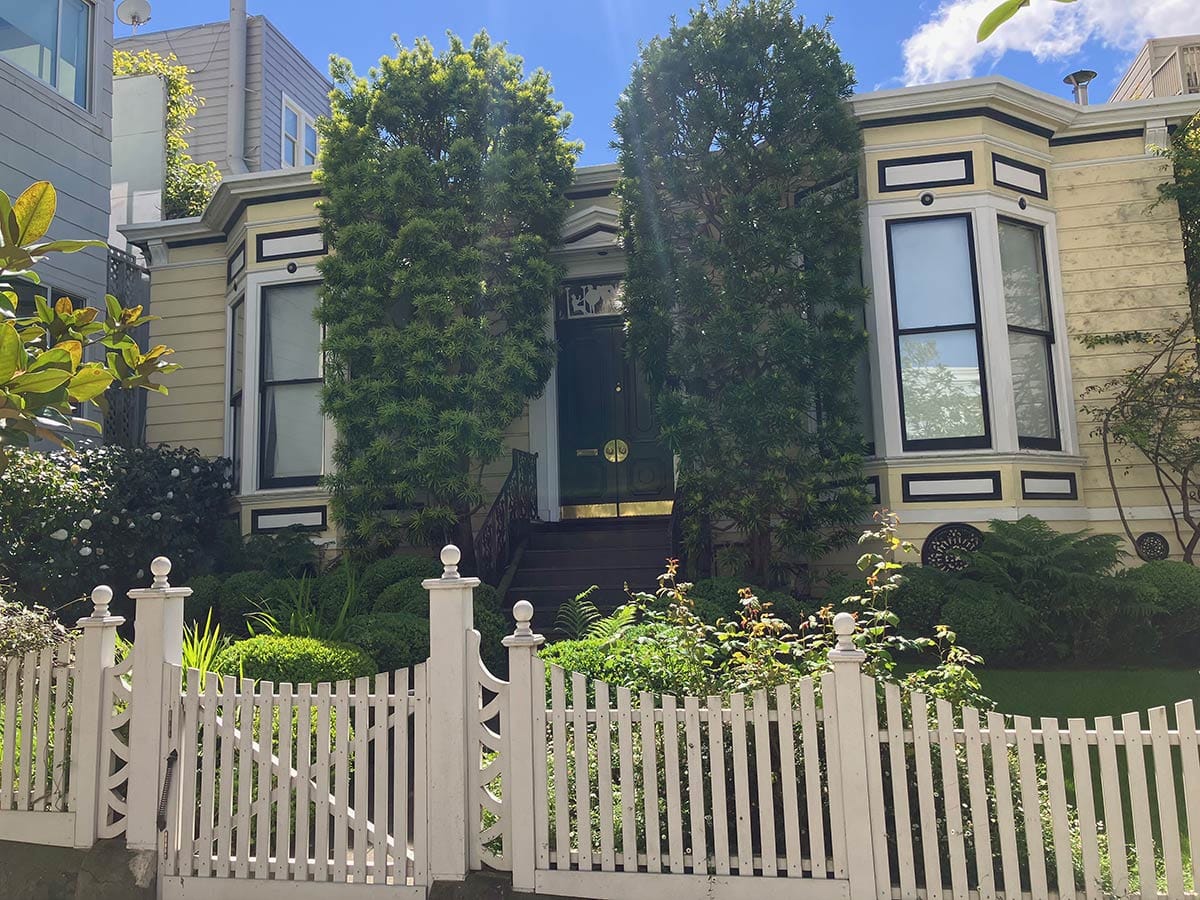
By 1961, there were just two Tucker Town houses standing. Today, there is one:
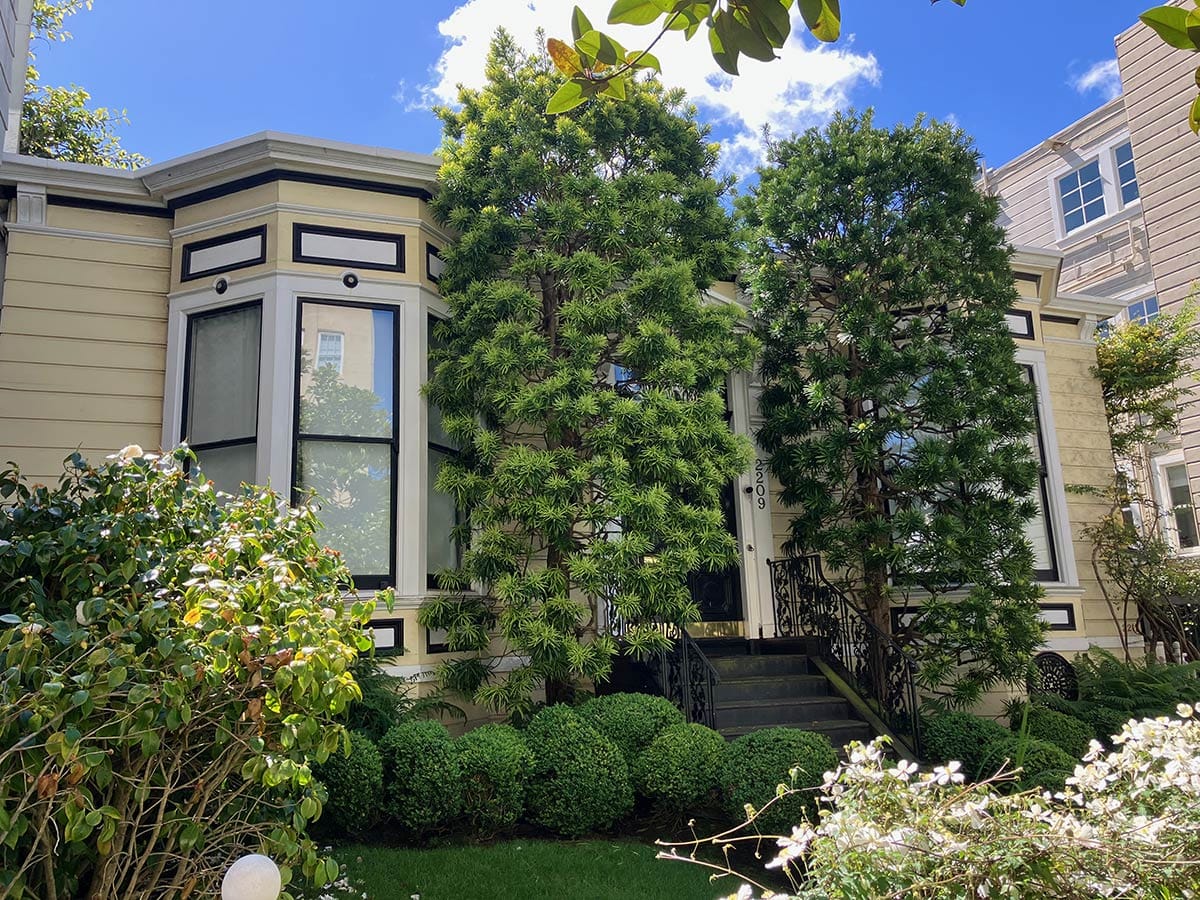
Dr. Richard Smith and his partner, both appreciators and collectors of historical furnishings and antiques, saved 2209 Jackson Street from the bulldozer in the 1950s. They occasionally opened their home up for some of the city’s earliest architectural heritage tours in the 1960s.
The last of Tucker Town has no official historic designation. As perhaps the city’s oldest standing tract house, it should.
Woody Beer and Coffee Fund
I am having a great time meeting people for coffee or beer and talking about... well everything. It is all thanks to the good folks who contribute to the Woody Beer and Coffee Fund. You, yes, you, can take advantage of this windfall and have a drink with me.
When are you free?
Sources
“Arson,” Daily Alta California, September 17, 1865, pg. 1, col. 2.
“Two Fine Cottage Houses,” San Francisco Call, September 15, 1870, pg. 2.
“Practical Homesteads,” San Francisco Chronicle, October 20, 1870, pg. 3.
San Francisco Call, March 16, 1871, pg. 2.
“Building Matters,” San Francisco Bulletin, August 26, 1872, pg. 3.
“On Pacific Heights,” San Francisco Examiner, August 25, 1889, pg. 14.
Walter J. Thompson, “Out Where the ‘Shelly-Cocoas Grew,’” San Francisco Chronicle, Magazine Section, pg. 27.
Millie Robbins, “The Subdivision Pioneer,” San Francisco Chronicle, December 4, 1961, pg. 50.
Judith Anderson, “A Tour of the City’s Historical Homes,” San Francisco Chronicle, September 29, 1970, pg. 21.