
A Room at Clark’s Point
Fremont's Family Hotel held a prominent place in San Francisco in 1849.

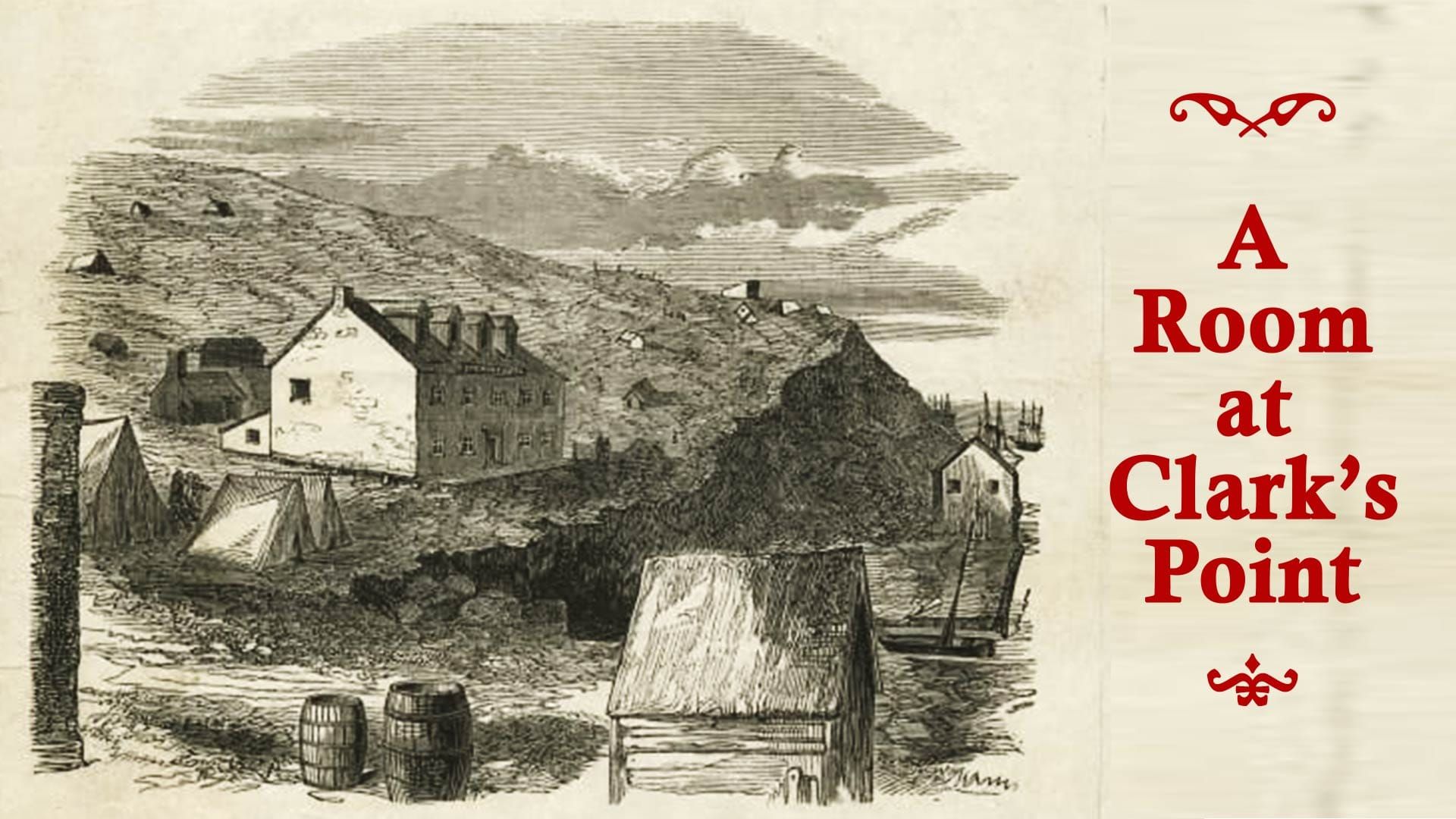
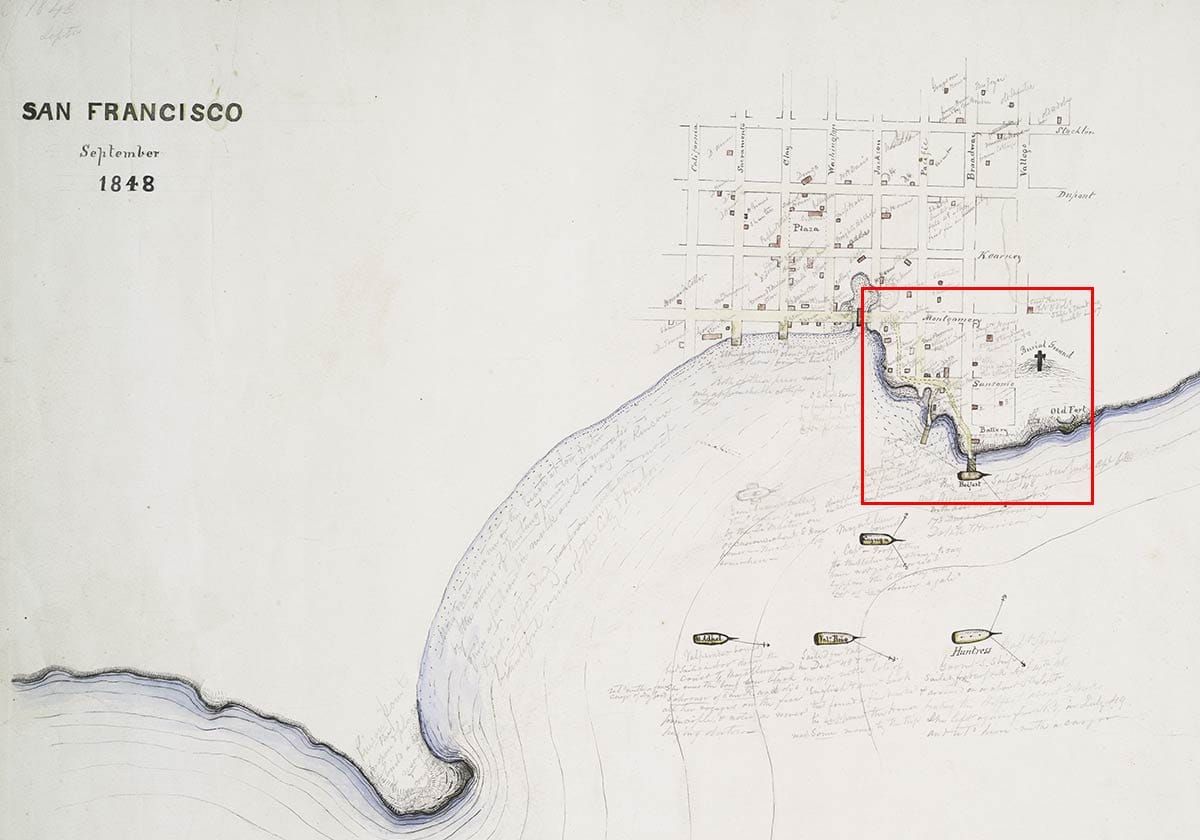
At the dawn of the California Gold Rush, most of the early arrivals to San Francisco by sea came ashore at the southeastern edge of Telegraph Hill, land claimed by William S. Clark and called Clark’s Point.
Clark’s Point marked the northern edge of shallow, muddy Yerba Buena Cove and Clark began building a fairly humble wharf there just before news of the discovery of gold in the Sierras reached the town of San Francisco in the spring of 1848.
Today the location corresponds with Broadway near Front Street, with the old cove to the south completely filled in by San Francisco’s Financial District.
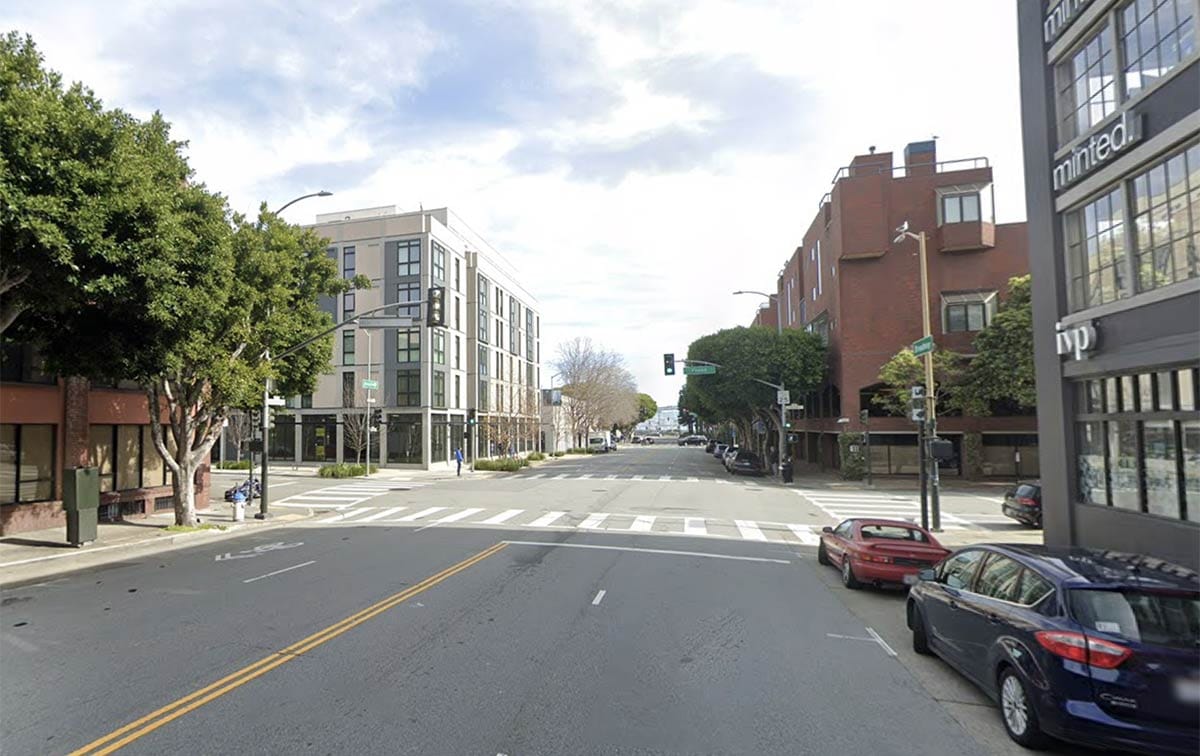
One gold rusher recalled pulling in to Clark’s Point in 1849 and seeing “the rising slope of Telegraph Hill directly in front,” and to the left, “the low water line, the sandy beach, the sand dunes covered with chaparral and scrub oak…”
But what he saw directly in front of him as he landed “was the largest building of any kind in this city […] on a bank, the edge of which was what is now the western line of Battery Street. It was, from the prominent position it occupied, the most striking object which met the eye of those who came into port.”
This was the Fremont Family Hotel, an enterprise of the house and ship carpenters, William Hood and Charles Wilson.
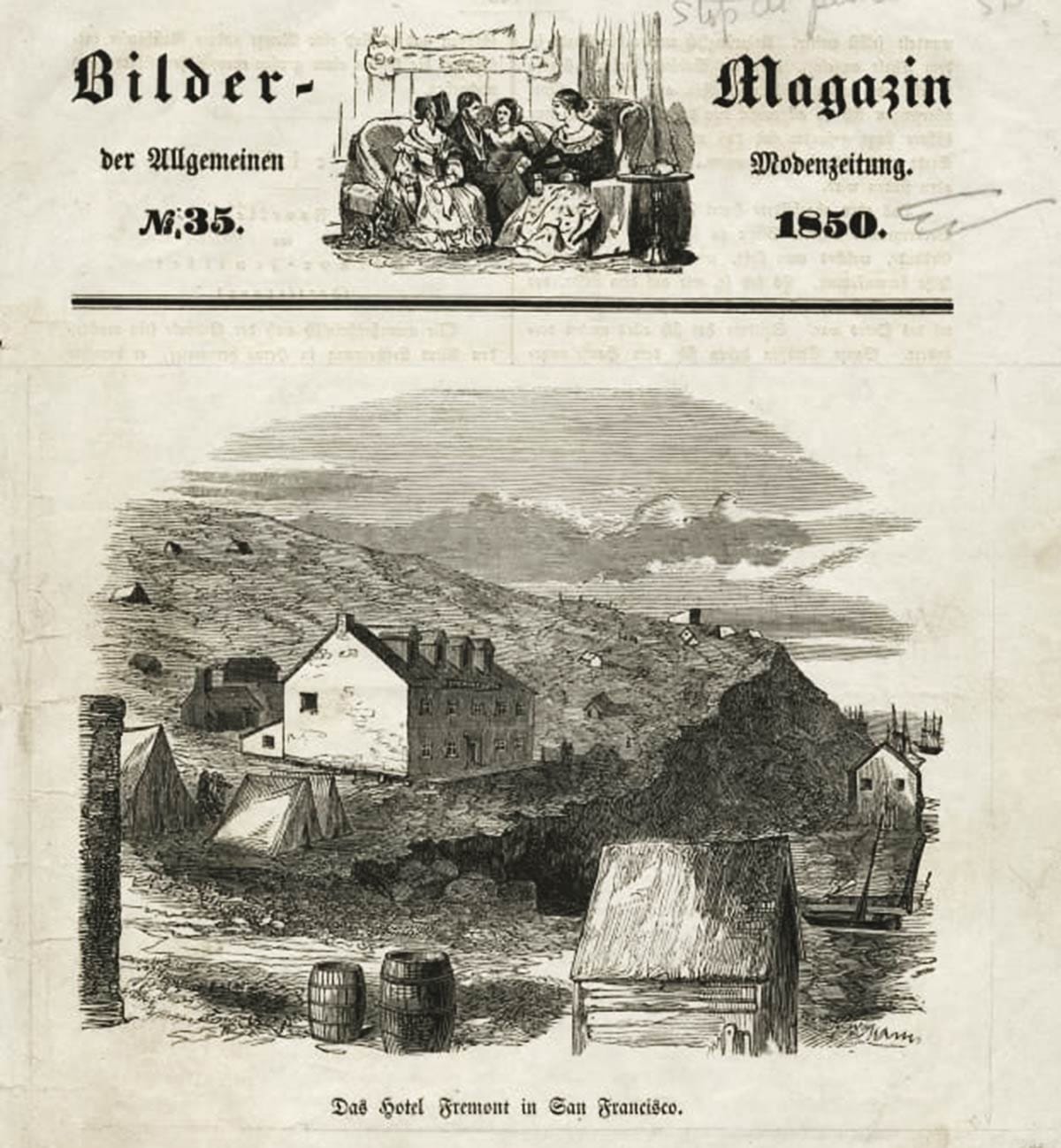
Named after “pathfinder,” self-promoter, and general problem, John C. Fremont, the two-story building with its four dormer windows opened for business in 1849 and had a great location to suck in the arriving gold seekers.
Clark’s Point was the most suitable place to land for the Argonauts pulling in via lighters, whale-boats, and dug-outs from ships anchored in deeper water.
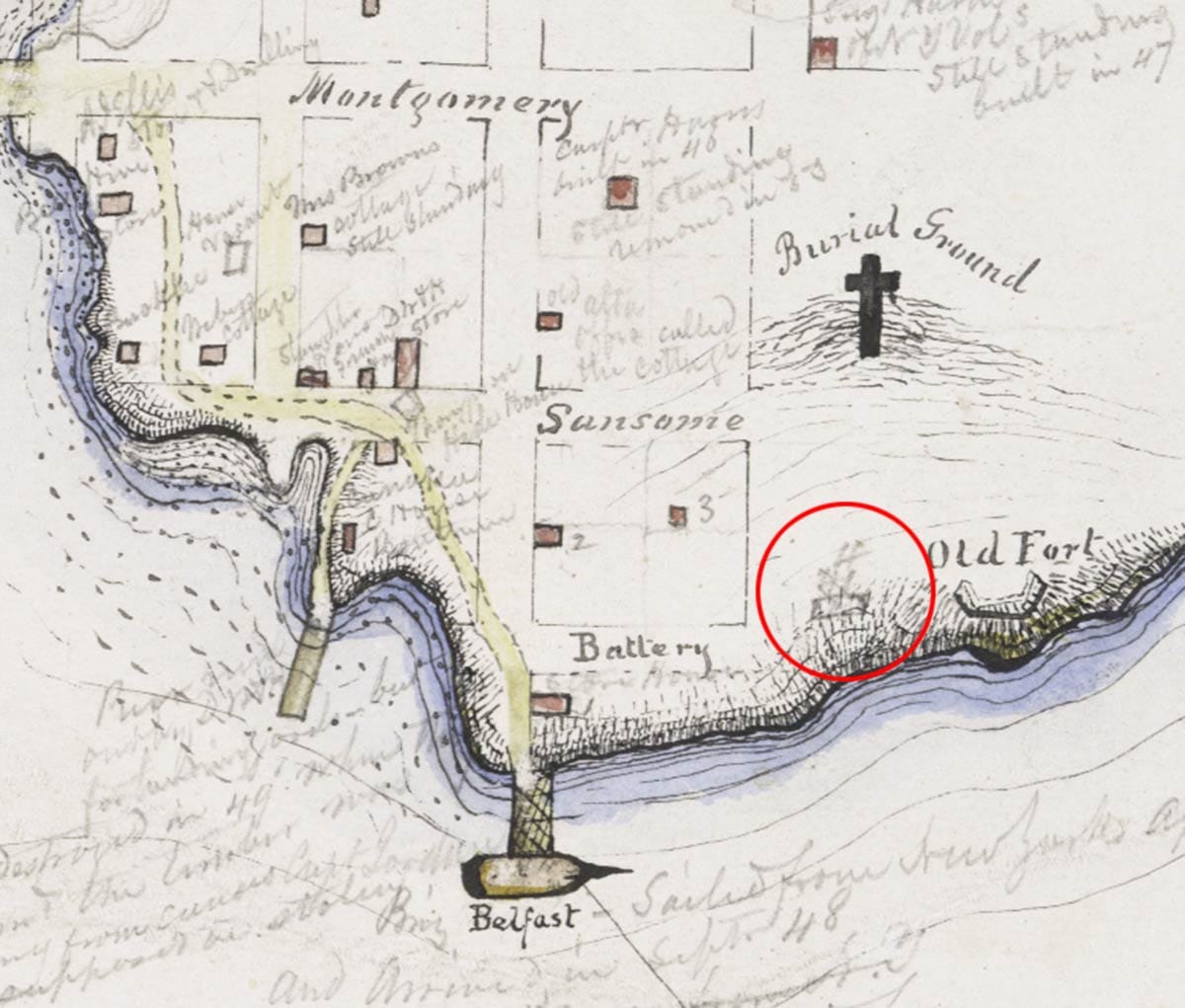
A room at the Fremont Family Hotel at Clark’s Point was considered “a luxurious home for those who were fortunate to have secured lodgings there.” Ads for the business were published as far away as Germany. Its prime location, standing where “ships rode at anchor within a stone’s throw of its door-yard,” must have made the proprietors a mint in 1849-1850.
But 300,000 arriving gold-seekers need a lot of bed space. The mad entrepreneurial zeal of the Gold Rush meant competitive advantages were lost quickly. New hotels and housing options of all kinds popped up across the sandy dunes at the cove.
Humble Clark’s Point soon lost its preeminence to a frenzy of wharf building. In the summer of 1850, the Alta reported the cutting away of Telegraph Hill’s bank north of the Fremont hotel to access new piers capable of hosting “floating large class vessels and steamers.”
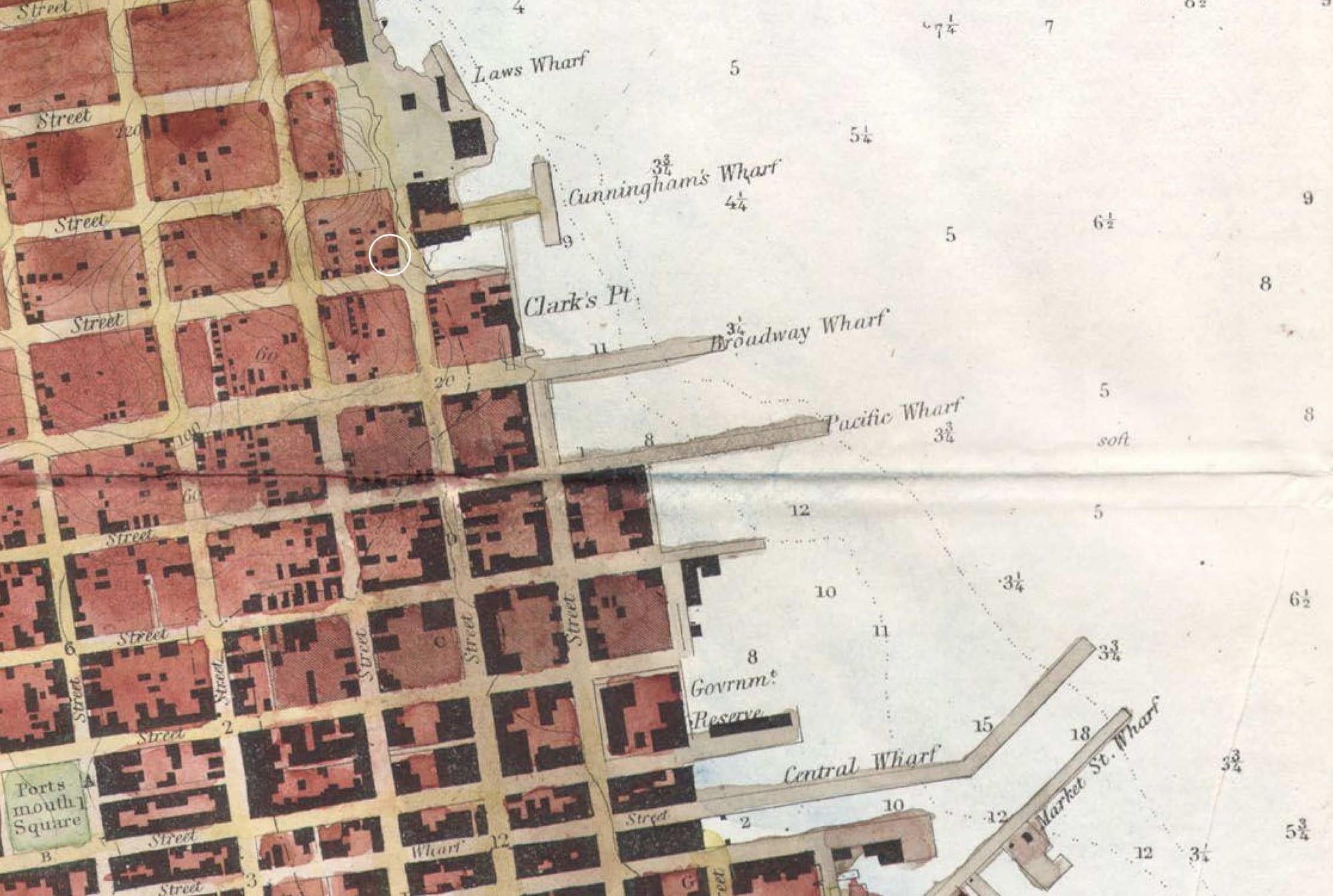
South of the hotel, entrepreneurs began construction of Central Wharf in 1849 at today’s Commercial and Montgomery streets. In 1850, wharves pushed out from Market and Pacific streets and more followed, extending to deeper water from Sacramento, Washington, Jackson, Clay, and Vallejo streets.
By 1853, Fremont House found itself in a metaphorical backwater of the city.
An Old Relic
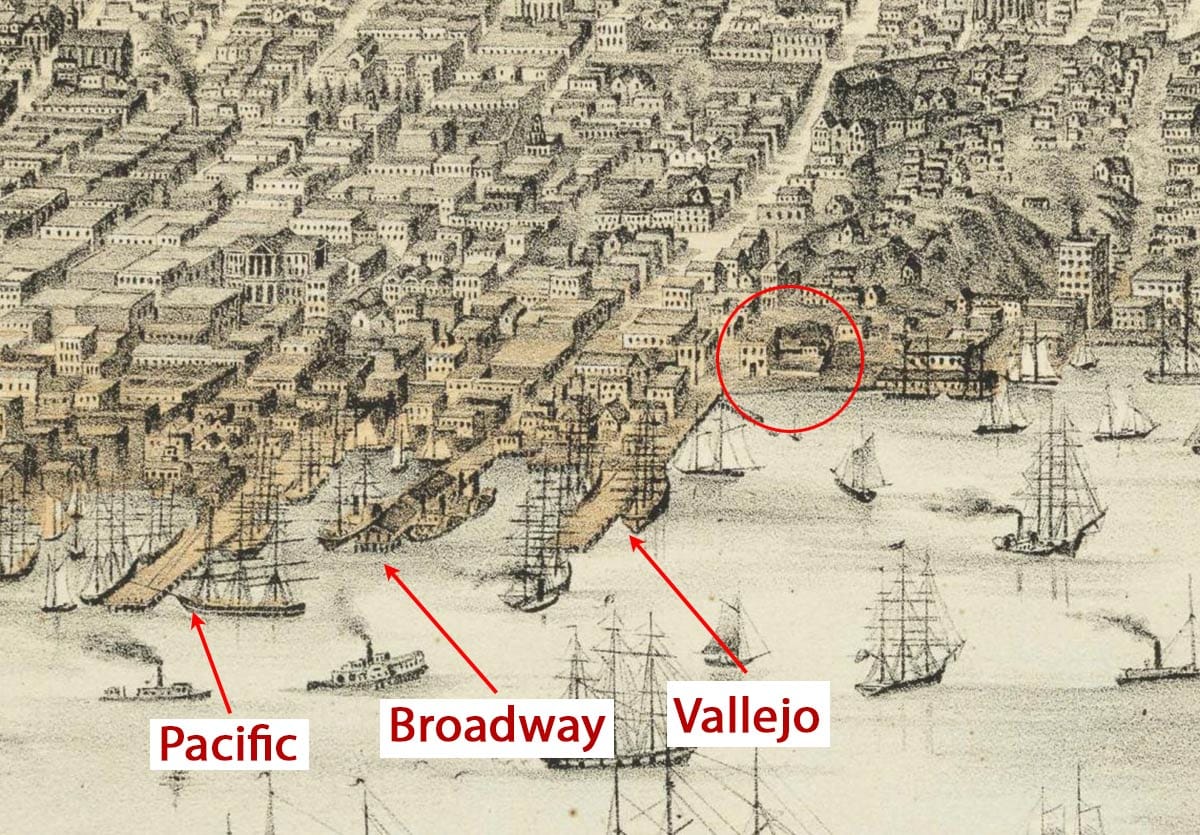
In 1857, the Alta called “the old Fremont Hotel” (built just 8 years earlier) “a speculation which did not result very favorably” because the cliff sides all around the hotel had been carved away for ship ballast and street-making.
By the next year, 1858, the Fremont was called “an old relic,” an “ancient and venerable building” surrounded by large storehouses. It was land-locked, “lonely and deserted,” blocks from the waterfront, which was still being extended east. The Gold Rush hotel had lost its foundation completely to ballast-hunters and stood on posts 10 feet above those excavations.
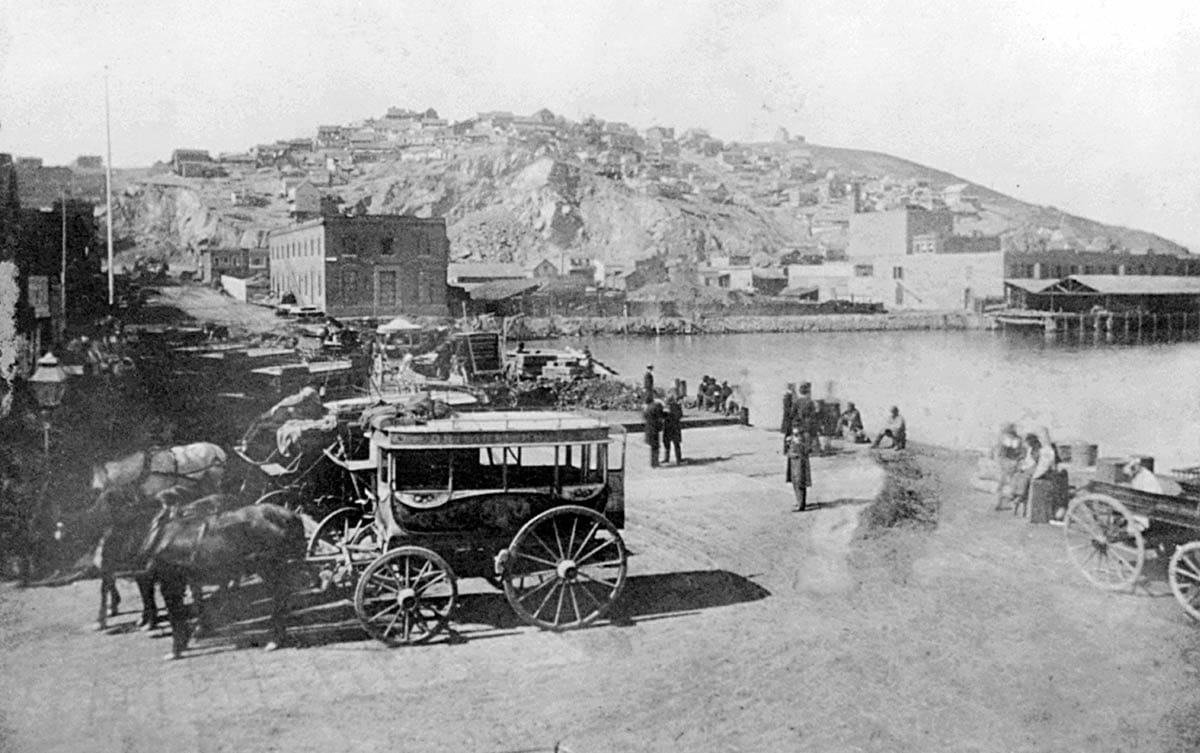
Less than a decade after its construction, less than a decade removed from its status as one of the most imposing and luxurious of buildings, the state of the Fremont was assessed by a reporter:
“Its glory has departed and it wears the appearance of an old rickety, dusty old tumble-down edifice, with none so poor to make a shelter of its roof, except those well known denizens, the rats of San Francisco.”
In a city where the new is always prized and a decade-old building is a relic, the Fremont structure somehow held on for almost another 50 years.
The old hotel was used as a private hospital before transitioning into a rooming house for Italian immigrants. At the dawn of the 20th century, it was still standing on Battery Street, 60 feet north of Vallejo Street and set into a tidy row of wood-frame buildings next to a blacksmith shop.
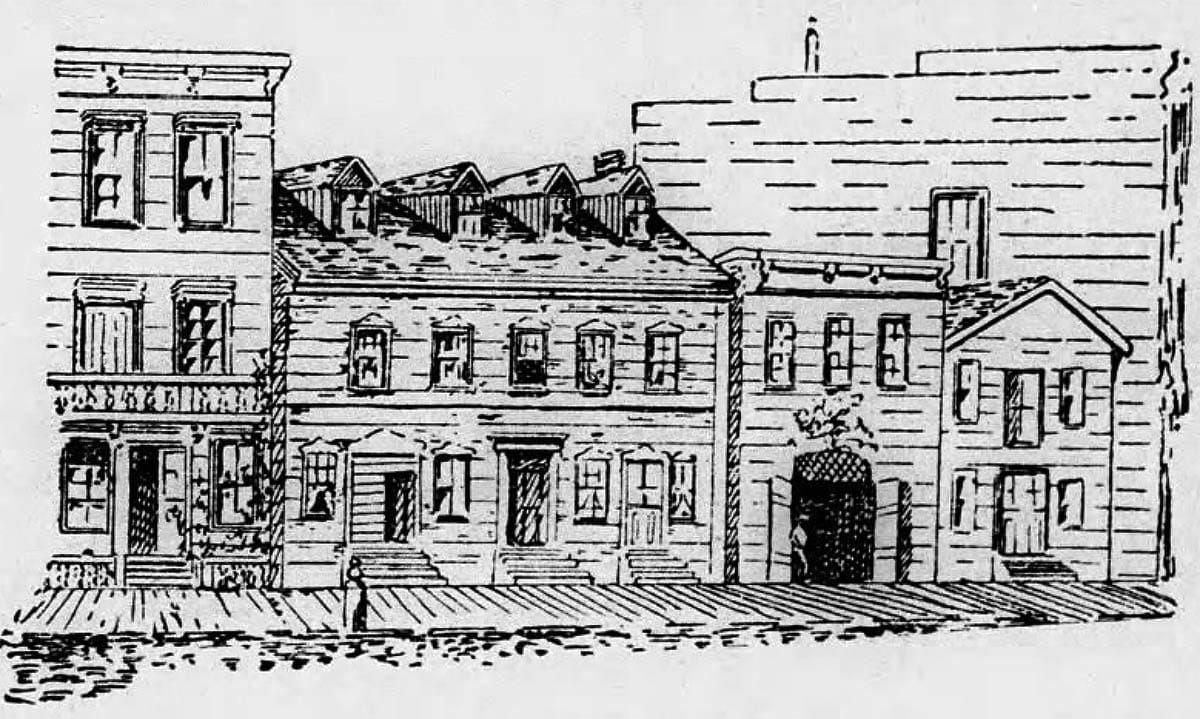
While recognized in the 1890s as one of the oldest structures in San Francisco, it was still judged as much of a wreck as it had been in 1858:
“Above the line of the cornice may be seen evidences of the ravages of time, decay and neglect. More than one-half of the panes of glass in the little dormer windows have been shattered, while the remainder are covered with cobwebs and the accumulated dust of years.”
The survivor of multiple fires in the city (five major ones just between 1849 and 1851), the old Fremont Family Hotel building likely met its end in the city’s biggest one. The entire block was wiped out by the great conflagrations following the April 18, 1906 earthquake.
The former location of the Fremont Hotel is today occupied by a large building, 901 Battery Street, which began life as the Petri Cigar Company.
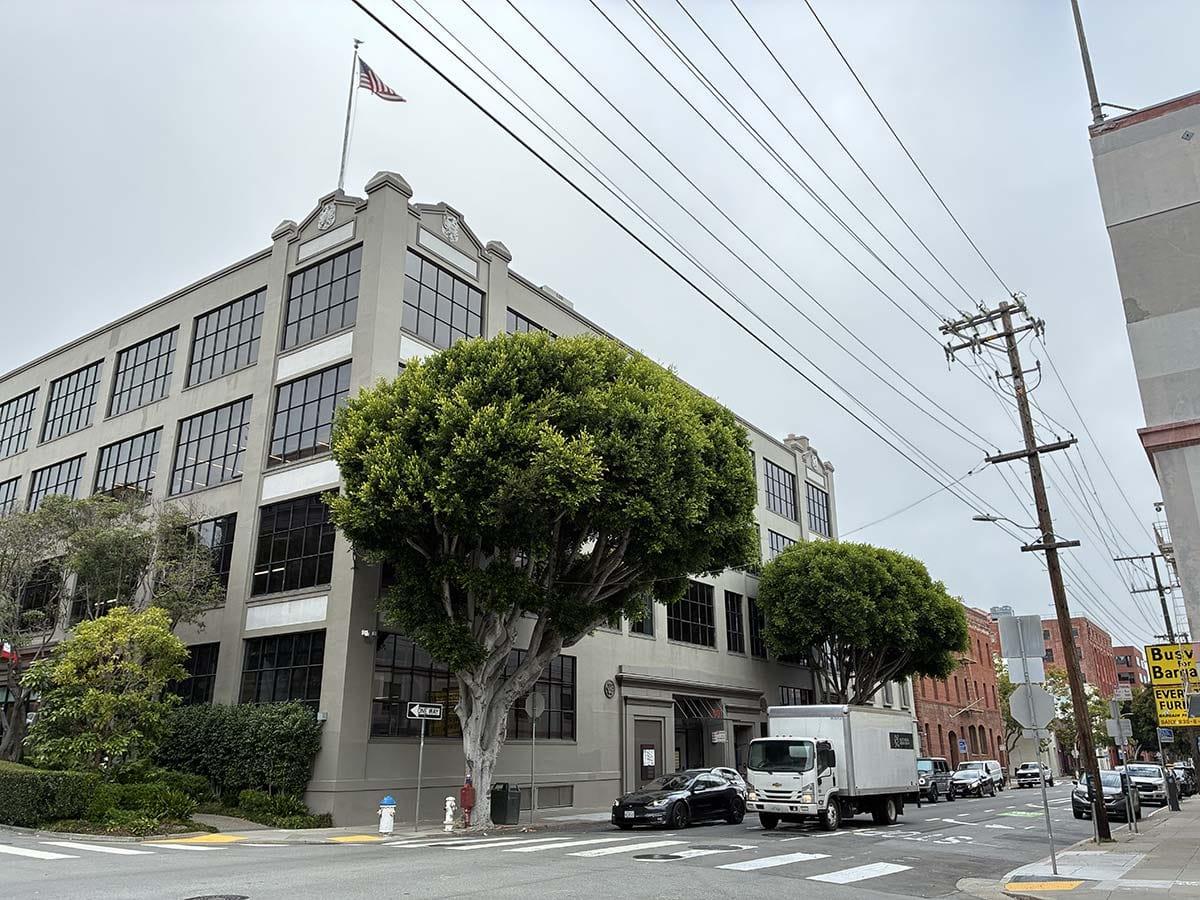
Built in 1923, the cigar factory warehouse has stood almost half a century longer than the old Fremont Hotel lasted and is included in a Northeast Waterfront Historic District.
It took a while, but maybe San Franciscans started appreciating having some old relics around.
Woody Beer and Coffee Fund
Nancy and I are off to Canada for a week to look at mountains and, um, maple trees or whatever they have up there. But we can schedule something for July perhaps? Your beverage is already paid for by generous folks like Stephanie S. (F.O.W.) and Christine G. (also F.O.W.).
Sources
“Broadway Wharf,” The Californian, April 12, 1848, pg. 2.
City Improvements,” Daily Alta California, July 19, 1850, pg. 2.
“City Items,” Daily Alta California, October 16, 1857, pg. 2.
“An Old Relic on Stilts,” Daily Alta California, August 27, 1858, pg. 1.
“City Wharves,” Daily Alta California, November 29, 1863, pg. 1.
“The Fremont Hotel,” San Francisco Call, November 16, 1890, pg. 13.